01. Find your story
Make: A short story brief and a list of the moments the audience needs to see.
You can start with a script, a drawing, music, or a feeling. Before generating the film, turn that starting point into something that happens.
Turn a feeling into an event
"A film about kindness" is a direction. It does not yet tell you what to show.
A traveler hurries through a station, notices a forgotten umbrella, and stops to leave it somewhere its owner can find it.
Now you have a person, a place, a choice, and a visible result. Name the change in a short phrase: rushing becomes paying attention, doubt becomes trust, or isolation becomes connection. Use it to judge what the scene needs.
Write four lines for your own brief:
- At first: What is the character doing or trying to do?
- Interruption: What makes them respond?
- Choice: What do they do instead?
- At the end: What can the audience see has changed?
Not every film needs a conventional plot. An observational or music-led film can use a change in attention, rhythm, or mood. Still decide what develops across the sequence, rather than collecting unrelated attractive shots.
Name the story's core idea
Write one sentence naming what wins or is lost, and why. This is the controlling idea: the meaning supported by the ending, not a slogan a character has to say.
Care wins over haste because the traveler stops to leave the umbrella where its owner can find it.
Use this sentence to judge the film. Does the final action support it? If the story develops a different meaning, revise the sentence rather than forcing the scene to prove it.
Check the connections
Read the beats as causes and consequences, not just events in order.
The traveler wants to leave, but notices the umbrella. They stop to help, so the umbrella ends up visible beside the bench rather than being carried away.
If two beats have no connection, ask whether you need a missing reaction, a clearer motivation, or a different order. Do not solve an unclear choice by adding more detail to the background.
Make the choice matter
Ask what the character wants, what gets in the way, and what choosing costs. In the simple station story, helping costs a little time and attention. That may be enough.
For an optional higher-pressure version, the traveler wants to help and catch a departing train, but cannot do both. You would need to establish the deadline and show the consequence. Do not add a missed train to the core exercise without adding that information.
For each planned scene, note its starting state, ending state, and the choice or event connecting them. If nothing develops, ask what the scene contributes before polishing it. This is a story test, not a rule that every scene must contain a dramatic reversal.
Let the result challenge the plan
A useful turn can come from a gap between what a character expects and what actually happens. The result should affect their next choice.
In the optional train version, the traveler expects to find the owner nearby and help quickly. They look around, but no one is there; a departure announcement leaves little time. They must choose between leaving immediately and finishing the gesture.
Write three short notes: Expected result / Actual result / Next choice. Then identify the action or sound that lets the audience follow each one. A surprising image is not a story turn unless it changes something that matters.
Increase pressure, not repetition
If several scenes feel flat, check whether the decisions become harder. In the optional version, finding the owner gives way to running out of time, then choosing which goal to give up. Repeated views of a clock may only repeat the same problem.
For each scene, ask: What is harder now, and what new choice does that create? If neither changes, consider combining scenes or cutting repetition. Pressure can stay quiet and personal; the core exercise does not need extra obstacles.
Write what can be seen or heard
Replace an internal label with behavior:
| Abstract intention | Something you can direct |
|---|---|
| The traveler is in a hurry | They walk briskly toward the exit |
| They become concerned | They stop and look back at the umbrella |
| They choose to help | They leave the umbrella on the visible hook, then walk away without it |
For a dialogue scene, give each line a job: ask, avoid, reassure, or challenge. A character can ask about the timetable while their actions reveal concern for the umbrella's owner. Read the scene aloud, then remove lines that only announce a feeling the behavior already communicates.
Plan Before / Turn / After
Reduce one scene to three beats: meaningful steps in the action. For the simple station story:
- Before: The traveler crosses the station in a hurry. Show their direction and the space they are passing through.
- Turn: They notice the forgotten umbrella, stop, and turn back. Show the discovery and the decision, not just a portrait.
- After: They hang the umbrella on the hook and leave without it. Make the changed priority and the object's final location clear.
For each beat, write a subject, a visible action, and a purpose. "A traveler at a station" names a setting. "The traveler stops, looks back at the red umbrella, and turns toward it" gives you a moment to direct.
These are three story beats, not a requirement for exactly three camera shots. One continuous shot can contain several beats; a beat can need several views. 04. Plan shots that cut together expands the same story into six shots.
Arrange simple sketches or existing stills on the canvas. Ask someone what changes without first explaining the theme. If the turn is unclear, revise the action or framing before generating the rest.

Three sampled moments show a person approaching a food display, reaching for an object, and moving away. They demonstrate observable action, not by themselves an emotional change. Identify both in your own scene.
Keep the first film small
Use one location and only the characters, props, and events needed for the change. A clear ending matters more than a long running time.
Mark the most uncertain moment. In this example, it may be the hand placing the umbrella on the hook. Plan an early test or a simpler way to show the result. Do not make every easy shot before discovering that the ending cannot be read.
Set your working limits now: available time, credits, and the point at which you will stop retrying and rethink a shot. Leave room for editing and revisions.
Put the brief in Flick
Keep the brief in a text node or your script notes. See Text Nodes or Script basics.
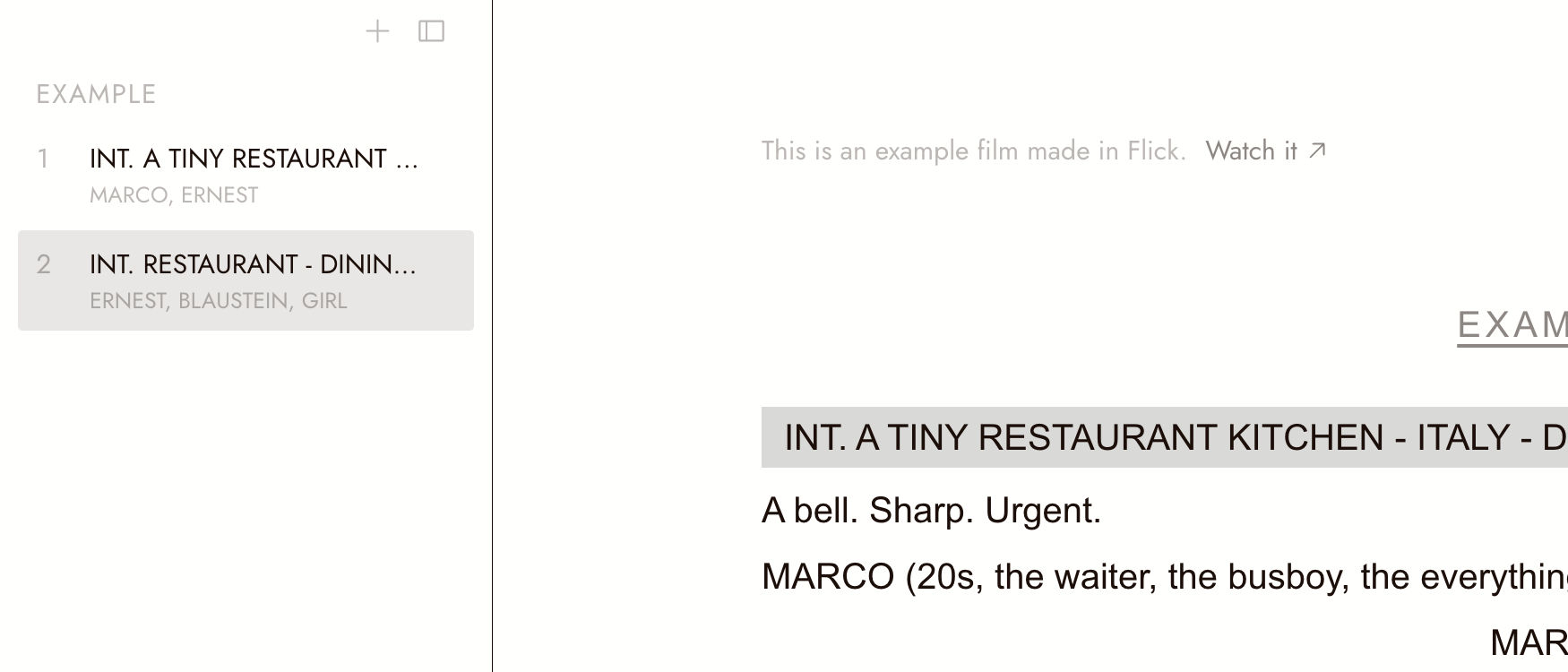
The Script scene rail lists scene headings and speaking characters. Use the scene list to review what each scene contributes; the interface does not decide that for you.
If you use the agent to explore ideas, respond with specific feedback: "Keep the quiet station. Remove the chase. Make the final gesture readable without dialogue." Review any proposed actions and costs before running them; a written request is not a spending lock. See Talking to the agent.
Keep the core idea and the Before / Turn / After notes beside your script. If the story changes during generation or editing, update the notes and check the ending again.
Before you continue
- I wrote what changes, why it changes, and what the character's choice costs.
- I mapped Before / Turn / After and checked that a viewer can follow the change.
- I kept the scope small, set working limits, and identified the most uncertain moment to test.
Source: The story-change and choice exercises adapt ideas from Robert McKee's Story. The station examples and three-beat worksheet are original teaching exercises. Further reading: controlling ideas and expectation versus result.
Next: 02. Build your visual world.