Panel 1: la caja
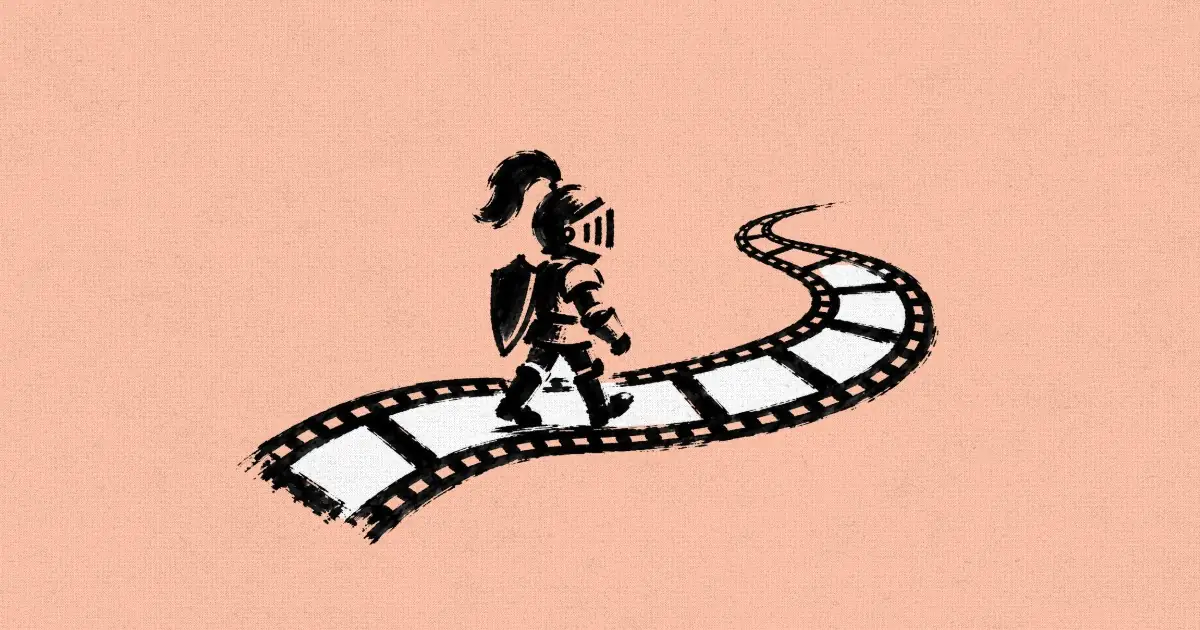
Unas manos abren una caja y encuentran un caballero.
A Proper Introduction, dirigida por Jaime Yao
Para hacer una tira cómica con IA, escribe la historia en cuatro momentos, dibuja cada momento como un panel, coloca los bocetos en fila para probar la lectura, luego haz que un modelo de imagen termine cada boceto y rotula las palabras.
Por Zoey Z.Última actualización
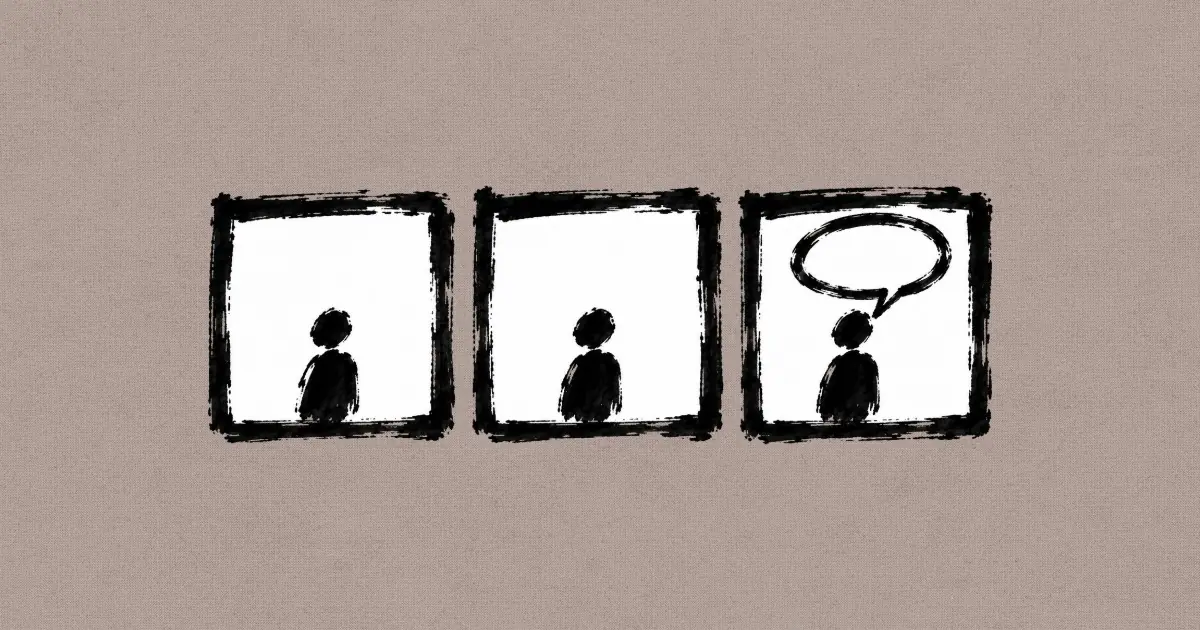
La mayoría de las guías sobre cómo hacer una tira cómica se detienen en consejos sobre paneles, mientras que la mayoría de las herramientas de IA empiezan desde un prompt de texto y dejan el encuadre al azar. Jaime Yao, el cineasta interno de Flick, trabaja de manera opuesta: 269 de las 896 imágenes con prompt en el lienzo público de A Proper Introduction, un cortometraje de 5:45, nombran un boceto proporcionado como su referencia. Jaime hizo estos bocetos para planificar una película, y colocamos cuatro de ellos en fila para mostrar el método. Esta guía lo recorre en ocho pasos, con cada boceto junto a lo que el modelo creó a partir de él.
| Parte | Qué es | Qué hace |
|---|---|---|
| Panel | Un dibujo enmarcado | Contiene un momento de la historia |
| Espacio entre paneles | El espacio entre los paneles | Marca el salto en el tiempo |
| Globo de diálogo | Una forma alrededor de las palabras habladas | Indica quién habla y se lee en orden |
| Cartucho | Un cuadro de narración | Indica el tiempo, el lugar o un pensamiento |
| Remate | El último momento | Gira o aterriza todo lo que hay antes |
Cuatro bocetos, dispuestos en tira
A Proper Introduction, dirigida por Jaime Yao

A Proper Introduction, dirigida por Jaime Yao

A Proper Introduction, dirigida por Jaime Yao

A Proper Introduction, dirigida por Jaime Yao
La fila y los títulos de los paneles son nuestros: Jaime hizo estos como bocetos de planificación para una película.
Lo que el modelo creó a partir de cada boceto

Use the provided composition sketch as the only composition reference.
Use the provided toy reference as the only subject reference.
Generate a photoreal live-action image.
Pure top-down overhead shot.
Composition 100% exactly match the provided composition sketch.
Camera angle 100% exactly match the provided composition sketch.
Framing 100% exactly match the provided composition sketch.

A small knight toy stands inside an open cardboard box.
The knight toy’s helmet shape, armor silhouette, body proportions, metallic material, pink engraved ornamental details, rope, anchor, and overall toy appearance 100% match the provided toy reference.
The subject is clearly a toy figure.
The toy stands upright in the center area of the box.

The box is an open-top apricot cardboard box placed on the ground.
The box has a long rectangular proportion, with width greater than height and height greater than depth.
The material is matte apricot cardboard with clearly visible fiber texture.
The box has a clean open rim, with visible interior space, inner walls, cardboard thickness, and realistic folded corner construction.
The exterior of the box carries a simple printed castle toy motif in a slightly darker apricot-brown tone.
The interior of the box is plain apricot cardboard.

A pair of adult hands and part of the forearms are visible around the box, following the composition sketch.
The visible clothing is a gray knit sweater.
The sweater has a soft wool knit texture and a simple everyday appearance.
The hands, sleeves, and arm placement 100% follow the sketch.

The box is resting on pale gray concrete ground.
The concrete surface is flat and even.
The concrete shows light usage marks, subtle dirt, very faint hairline cracks, clearly visible poured concrete joint lines, and a small number of scattered dry leaves.
The ground texture is clearly readable from the overhead view.

The lighting is outdoor morning light.
Early morning sunlight falls diagonally across the frame from above.
The light has a natural warm tone.
The box, toy, hands, and leaves all cast clear but soft morning shadows.
The shadow direction is consistent and reads as a low-angle morning sun.
The light is bright and natural, with clean outdoor air.
The overall image feels like a real outdoor morning photograph.

The overall image reads as a clean and clear pure overhead shot.
The box remains the main shape in the frame.
The toy is clearly readable inside the box.
Realistic cardboard texture, realistic toy metal texture, realistic sweater texture, realistic concrete texture, subtle film grain, slight sensor noise, mild lens softness, very subtle chromatic aberration, natural imperfect real-camera rendering.

Use the provided sketch as the only composition reference.
Use the provided man reference as the only face, body, and clothing reference.
Use the provided knight toy reference as the only toy reference.
Use the provided box reference as the only box reference.

Convert the image into photoreal live-action.
Composition 100% exactly match the provided sketch.
Camera position 100% exactly match the provided sketch.
Framing 100% exactly match the provided sketch.

This is a low-angle close shot inside the home office.
The man sits behind the desk, looking down at the little knight toy in his hand.
The man’s face is visible.
The man’s facial structure, age, hairstyle, skin tone, and body proportions 100% match the provided man reference.
The man wears a gray-blue knit sweater, with the material, color, and loose everyday fit matching the provided man reference.

One hand holds the little knight toy.
The back of the little knight toy faces the camera.
The helmet, armor silhouette, drawing tube on the back, metal material, and pink engraved ornamental details of the toy 100% match the provided knight toy reference.
The man looks at the toy.

The lower foreground is an apricot open-top cardboard box.
The box position, visible height, and frame coverage 100% match the provided sketch.
The box is a lidless open-top cardboard box.
Only the outer side wall and upper rim of the box are visible.
The box is heavily out of focus, reading only as a soft apricot cardboard foreground shape.
Do not emphasize box construction details.

On the right side of the frame is the back of a black computer monitor.
The monitor has a silver stand.
The monitor position, size ratio, and blocking relationship 100% match the provided sketch.
The monitor remains slightly out of focus.

A black office chair sits behind the man and behind the desk.
The chair has a wide rounded black backrest.
The backrest material is black fabric or matte black woven material.
The chair has black plastic armrests on both sides.
The dark shape visible near the lower part of the frame is part of the office chair armrest.
The office chair remains slightly out of focus as midground furniture.

The background is a muted olive / gray-green home office wall.
Behind the man is a window with white trim and white muntin bars.
The window occupies the background behind the man.
Outside the window, tree branches and leaves are visible.
The outdoor branches and leaves are heavily out of focus, reading only as soft green and brown light shapes.

The lighting is strong window backlight.
Intense early morning sunlight enters from the window behind the man.
The window area is very bright with obvious soft white bloom.
The window frame edges, head outline, shoulder outline, finger edges, and toy metal edges catch bright backlit rim light.
The little knight toy’s metal edges catch strong warm highlights.
The front of the man’s face and sweater stay in darker indoor shadow.
The room remains mostly dim, with the window as the brightest light source.
Strong light contrast and visible backlight bloom.

Focus on the little knight toy and the fingers holding it.
The toy back, drawing tube, and finger contact area are sharp.
The man’s face is slightly softer.
The foreground box is heavily out of focus.
The computer monitor is slightly out of focus.
The office chair is slightly out of focus.
The outdoor branches and leaves are heavily out of focus.

realistic knit sweater texture, realistic skin texture, realistic toy metal texture, realistic cardboard color blur, realistic monitor material, realistic black fabric office chair texture, strong backlight bloom, subtle film grain, slight sensor noise, mild lens softness, very subtle chromatic aberration, natural imperfect real-camera rendering.

Use the provided sketch as the only composition reference.
Use the provided man reference as the only character and clothing reference.
Use the provided knight toy reference as the only toy reference.

Convert the image into photoreal live action.
Composition 100% exactly match the provided sketch.
Camera position 100% exactly match the provided sketch.
Framing 100% exactly match the provided sketch.

This is a close shot inside a modest American home office.
A man in a gray-blue knit sweater is seated in front of a window.
His facial structure, hairline, skin tone, and sweater texture match the provided man reference.
He holds a sketchbook in one hand and a pencil in the other hand.
He is looking downward at the sketchbook while drawing.
The sketchbook is angled toward the camera.
The visible page stays mostly simple.

A small knight toy appears in the foreground near the lower right area of the frame, positioned against the near edge of the sketchbook.
The toy is shown from the back.
The helmet shape, armor silhouette, pink engraved ornamental pattern, and the drawing tube on the back 100% match the provided knight toy reference.
The toy is clearly visible as a small foreground figure.

Behind the man is a white-framed window with white muntins.
Outside the window, tree branches and leaves are visible.
The branches and leaves are heavily out of focus and read only as soft green and brown bokeh.
The outside view reads only as soft defocused color and light.

Strong early morning sunlight enters from the window behind the man.
The shot uses strong window backlight.
The window area is very bright.
There is obvious soft white bloom around the bright window.
Bright rim light appears along the window frame edges, the man’s head outline, shoulder outline, finger edges, the sketchbook edge, and the metal edges of the knight toy.
The light feels like strong morning sunlight from behind.

The wall color is muted olive / gray-green.
The overall color palette is soft, warm, and natural.
Realistic skin texture, realistic knit sweater texture, realistic paper texture, realistic pencil texture, realistic metal toy texture.
Subtle film grain, slight sensor noise, mild lens softness, very subtle chromatic aberration, natural imperfect real-camera rendering.

Use the provided sketch as the only composition reference.
Use the provided knight turnaround sheet as the only design reference for the tabletop knight figurine.
Use the provided knight pencil sketch as the only reference for the sketchbook drawing content.

Generate a realistic top-down tabletop scene.
Composition 100% exactly matches the provided sketch.
Camera angle 100% unchanged.
Framing 100% unchanged.
Object placement relationships 100% unchanged.

Show a close top-down view of a warm medium-brown wooden desk.
The entire tabletop is illuminated by morning sunlight.
Morning sunlight falls diagonally across the desk and creates a natural bright sunlit area on the wooden surface.
The sketchbook is placed in the upper area of the frame.
The tabletop knight figurine is placed in the lower-right area of the frame.
The size relationship between the sketchbook and the figurine 100% follows the sketch.
The sketchbook is open flat, with page orientation matching the sketch.
The sketchbook page shows the provided knight pencil sketch, and the drawing appears upside down in the frame.
The drawing remains clearly readable and looks like a refined graphite pencil sketch.

The tabletop knight figurine 100% matches the provided knight turnaround reference.
Show only the parts of the figurine that are actually visible from this top-down view.
Do not proactively add design elements that are not visible from this angle.
The figurine is the main sharp focus subject on the desk.
Focus is on the figurine.
The sketchbook is slightly softer than the figurine but still clearly readable.

Show real wood grain on the desk surface.
The morning sunlight is bright and natural.
The overall lighting feels like a quiet real morning interior.
The image should have a realistic photographic feeling.
Preserve real material detail.
Preserve slight depth of field.
Preserve subtle film grain.
Preserve slight lens softness.
The final result should look like a real photographed top-down desk scene, focused on the knight figurine in the lower-right area and the upside-down sketchbook drawing in the upper area.
La película necesitaba acción real, así que los cuatro son fotorrealistas; para una tira, mantén el mismo boceto y pide un acabado dibujado en su lugar, como muestra el paso a continuación.
Paso 1
Divide la idea en una introducción, un desarrollo, un giro y un desenlace antes de dibujar, porque una tira tiene espacio para un evento pequeño y su último panel tiene que rematarlo.

Paso 2
Dibuja cada golpe como un cuadro básico con la cámara y las figuras ubicadas, porque un boceto establece el encuadre y la escala antes de que un modelo pueda decidirlos por ti.

Paso 3
Si no puedes dibujar, pide a un modelo de imagen un boceto de storyboard del golpe, porque un dibujo de líneas simple es más rápido de juzgar y cambiar que una imagen terminada.

Use the provided small knight character reference as the only character reference.
Generate a simple storyboard sketch.
Hand-drawn storyboard sketch look, mainly line work with a small amount of simple shading, not too detailed.
The camera is extremely low, almost touching the floor.
The shot looks closely toward the lower part of a huge interior door.
The composition focuses on the bottom of the door, the door edge, the floor, and the narrow door gap.
The door occupies most of the frame and creates a strong oppressive scale.
Show only the lower section of the door.
The tiny knight stands near the bottom edge of the door.
He grips the edge of the door with both hands and pulls it open with effort.
His body leans backward clearly, and his feet brace against the floor. The action focus is visible strain.
The gap is narrow, but it is clearly readable that the door is being pulled open little by little.
A small area of sky-blue interior wall is visible through the gap.
The wall on the outer side of the door is olive green.
The door is an aged light-ivory wooden door.
A small patch of sunlight falls on the floor and the door edge.
The core of the image is the strong scale contrast between the huge door and the extremely tiny knight.
The shot should read immediately as: the tiny knight is struggling at the bottom of the door to pull it open.
Paso 4
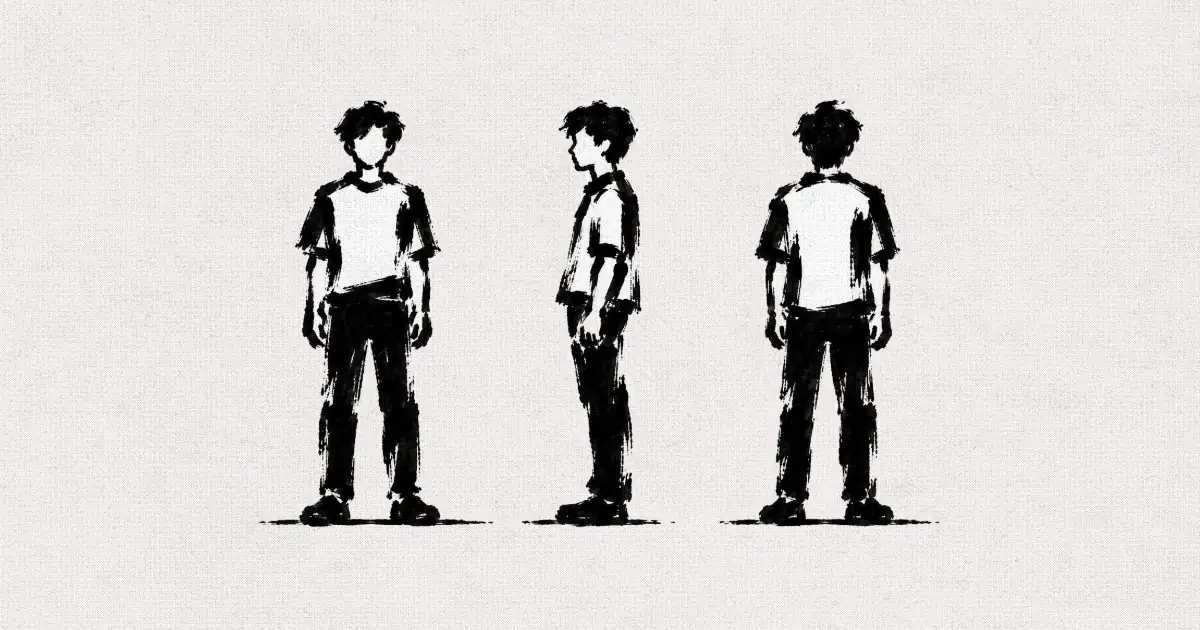
Haz una hoja para cada personaje con vistas frontal, lateral y trasera sobre un fondo blanco, porque cada panel que termines después copia el personaje de esa hoja.

Create a full character turnaround and expression sheet for Mila based on this reference image. Layout: top row shows 4 full-body poses in a row: FRONT, 3/4 FRONT-RIGHT (body at 45 degrees), SIDE (profile), BACK. Bottom row shows 6 facial expression close-ups: HAPPY, SAD, SURPRISED, ANGRY, CURIOUS, LAUGHING. Keep her exact design from the reference: blue bob hair, red/orange skin, yellow spacesuit/jumpsuit, blue boots/shoes. Outlines only at joints and where different colors meet, no heavy interior outlines within same-color areas. Flat 2D illustration style, tricolor blue yellow and red/orange palette, white background. Label each pose and expression. Title: "Character Turnaround: Mila".
Paso 5
Crea una cuadrícula de las expresiones que tu tira necesita, porque el chiste de una caricatura normalmente recae en un rostro y una hoja te permite pedir el mismo rostro con una nueva emoción.

Create a professional character expression sheet for the gaunt old tailor man in Image 1, using his exact face, hair, and features. Show 6 different emotions in a 3x2 grid, each a head and shoulders bust portrait on a plain warm light gray seamless background. The 6 emotions are: 1) Worried and anxious, 2) Quietly determined, 3) Sad and defeated, 4) Surprised and wide-eyed, 5) Bitter and grumpy, 6) Rare warm smile. Match the exact stylized cartoon painterly style of Image 1: hand-painted textured brushwork, angular exaggerated proportions, large wide expressive eyes with dark circles, swept-back grey hair, muted earthy teal and ochre palette, bold graphic shapes. Same identical face and hair in every panel. Label each panel with the emotion name below it. Bust portraits only, no full body.
Paso 6
Dale al modelo cada boceto como su referencia de composición y describe un acabado dibujado con palabras simples, para que añada línea, color y luz mientras el encuadre que elegiste permanece fijo.

Use the provided base image as the exact composition reference.
Composition 100% exactly match the provided base image.
Camera position 100% unchanged.
Framing 100% unchanged.
Perspective 100% unchanged.
Scale relationships 100% unchanged.
Object placement 100% unchanged.
Floor layout 100% unchanged.
All floorboard seam lines 100% exactly match the provided base image.
All light shapes and all shadow shapes 100% exactly match the provided base image.

Convert the entire image into a hand-drawn colored concept sketch.
The image reads as a refined storyboard sketch or previsualization sketch made by hand.
Keep all objects and all proportions exactly the same, but redraw everything as a sketch with visible hand-drawn linework and visible drawing texture.

Use confident pencil and ink linework, visible sketch strokes, visible edge variation, rough construction marks, and hand-drawn contour lines.
Add soft colored pencil, gouache, or marker-style color blocking over the drawing.
Keep the color palette simple and readable.
The wall remains light blue.
The floor remains warm off-white wood.
The bed remains dark brown wood.
The toy ball remains orange-red.
The distant toy blocks remain simple colored blocks.

Preserve the exact lighting direction from the provided base image.
The strong sunlight still enters from above and creates the same large bright floor shapes and the same large shadow shapes.
Keep the lighting information clear and readable as painted light and shadow masses inside the sketch.

The image should feel like a hand-made color sketch for a film frame, with simplified surfaces, visible drawing decisions, visible paper texture, slightly uneven hand-applied color, and clear separation between line, color, light, and shadow.
Paso 7
Corrige un detalle incorrecto con un prompt de edición que indique qué permanece igual, para que un mostrador o una mano mal hechos no te cuesten una viñeta que por lo demás te gusta.

Change the kitchen countertop / front counter so it has a squared off rectangular shape with straight edges and sharp corners, instead of the current rounded curved edge. The counter should read as a clean straight rectangular block running across the front. Keep everything else exactly the same: the flat 2D pastel cartoon style, the blue-haired red-skinned woman in yellow tasting soup, the small blue cat-suit character, the steaming pot, the cabinets, hanging pans, wall chart and lighting all unchanged.
Paso 8
Dale al modelo de imagen las palabras exactas y dónde van, luego verifica cada letra y coloca las viñetas en fila, porque el rotulado es el último punto donde una tira puede salir visiblemente mal.

metti in basso al centro:
Written & Directed By
Katrin Ann Orbeta


Hand-drawn 2D animation, illustrated storybook, cozy retro-futuristic sci-fi, warm pastel palette, soft sepia linework, vintage children's book, gentle golden light, whimsical, nostalgic, cozy spaceship interior, cinematic parallax, subtle atmospheric animation. Negative Prompt photorealistic, 3D CGI, realistic rendering, glossy surfaces, hyper-detailed textures, anime, manga, thick black outlines, neon colors, high contrast, dark horror mood, dramatic lighting, fast camera movement, excessive motion, shaky camera, realistic modern kitchen, futuristic cyberpunk aesthetic, visual clutter.

Flat 2D animation style, soft semi-visible outlines, que se leen claramente en un tamaño de viñeta pequeño.Mila & Sasa, dirigida por Katrin Ann Orbeta

hand-painted painterly cartoon illustration style, gouache texture, que dan una sensación de libro de cuentos a una tira.Happy Souls Alive, dirigida por Simay Ezer Pekcan

more painterly and watercolor, que se adaptan a una tira delicada con pocas líneas y poco texto.Finishing Touch, dirigida por Sue Ellen Zhang
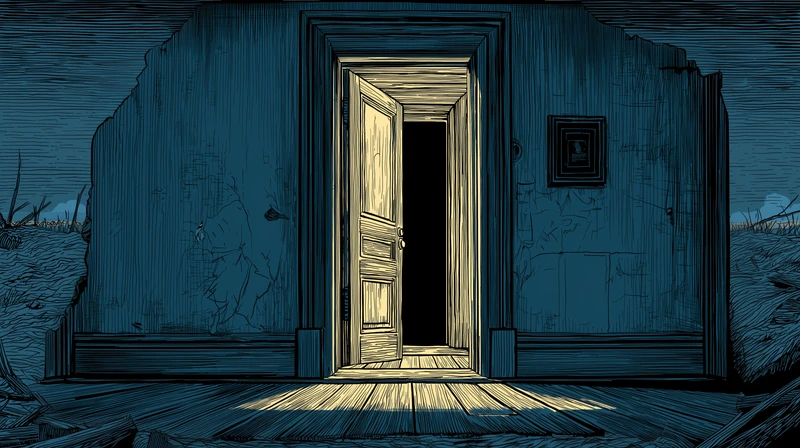
Line-art woodcut illustration style, limited blue color palette, que se adapta a una tira seria.In Our Time, dirigida por Jaime Yao
La mayoría de las tiras cómicas diarias usan tres o cuatro paneles, suficientes para una configuración, un giro y un remate. Un solo panel es adecuado para un chiste visual, y una página más larga funciona para una historia con varias escenas.
Significan lo mismo en el uso cotidiano: una secuencia corta de paneles dibujados con palabras, generalmente humorística. Comic strip es el término más común en Estados Unidos, y cartoon strip también se usa ampliamente en Gran Bretaña.
Sí. Un modelo de imagen puede dibujar una tira completa desde un solo prompt o completar cada panel desde un boceto y una hoja de referencia, y la segunda forma te da más control sobre el encuadre y el personaje. Tú sigues escribiendo la historia, eligiendo los cuadros y revisando cada palabra rotulada.
Crea una hoja de referencia con vistas frontal, lateral y trasera más una fila de expresiones, luego adjúntala a cada prompt de panel. Describe el vestuario con las mismas palabras cada vez, y edita un único detalle cuando se desvíe en lugar de generar el panel otra vez.
Pon las palabras exactas entre comillas en el prompt, indica a qué panel pertenecen y mantén cada línea corta. Revisa la ortografía en el resultado, luego corrige una palabra incorrecta con un prompt de edición o añade el texto en una aplicación de diseño.
Comienza por la escritura, ya que los ritmos y los diálogos deciden si una tira funciona. Luego pídele a un modelo de imagen un boceto simple de storyboard de cada momento, ajústalos y haz que el modelo los termine. Incluso unas pocas líneas toscas pueden servir como referencia de diseño.
Puedes empezar en Flick gratis, sin tarjeta de crédito, y crear o editar paneles con modelos de imagen como Nano Banana Pro usando créditos gratuitos. Animar un panel después requiere un modelo de video, y muchos de esos están en planes de pago.
Sí. Anima cada viñeta terminada con un modelo de imagen a video, bloqueando la cámara y nombrando las pocas cosas que se mueven, luego corta los clips en orden de lectura. Esa forma se llama cómic en movimiento, y se pueden añadir efectos de sonido y voces encima.
Cada fotograma y prompt en esta página proviene de los lienzos públicos de las películas listadas arriba y está acreditado a su cineasta. Mira más películas hechas en Flick en Flick TV.
Escribe los beats, boceta las viñetas, luego termina y rotula cada viñeta en un lienzo.
Prueba gratis, sin tarjeta de crédito requerida.
Pregúntale a una IA sobre esta página:ChatGPTPerplexityClaude