
How to Use MiniMax H3 Max in 2026: Fast AI Video with Sound
Oct 2026
MiniMax H3 Max turns a start frame into a video with sound, up to 15 seconds long, and it is fast: our 5 second 768p clip came back in 16 seconds. It is fal's post-trained version of MiniMax H3 (Hailuo 3), tuned for prompt adherence and looks. On Flick it runs in the image-to-video node and in Omni Reference, and it is available on every plan, including Free.
Quick answer: how do you use MiniMax H3 Max?
Connect a start frame to a video node, pick MiniMax H3 Max, and describe the action. Then:
- Start at 480p or 768p. 20 or 40 credits for 5 seconds, back in seconds.
- Name the action. It acted on "the woman is laughing" but barely moved on "animate it".
- Save 2K for the keeper. 2K adds a second pass: about 2.5 minutes in our runs.
| Spec | MiniMax H3 Max on Flick |
|---|---|
| Base model | MiniMax H3 (Hailuo 3), post-trained by fal |
| Released | MiniMax H3: July 31, 2026; H3 Max on fal: August 27, 2026 |
| Modes on Flick | Image to video (start and optional end frame), Omni Reference |
| Length | 5 to 15 seconds |
| Resolution | 480p (default), 768p, 2K |
| Audio | Native, generated with the picture |
| Price | 20 credits for 5 s at 480p; double at 768p, four times at 2K |
| Prompt expansion | Balanced (default) or Quality |
| Plans | Every plan, including Free |
| Measured time | 768p, 5 s: 16 s. 2K, 5 s: 2 min 34 s and 2 min 41 s |
Animate a still in seconds
MiniMax H3 Max: sound included, from 20 credits.
What MiniMax H3 Max is
MiniMax launched H3 on July 31, 2026 as a multimodal model that generates video with native stereo sound, up to 15 seconds and 2K by default. fal then released H3 Max, "a post-trained variant of MiniMax H3" tuned for "stronger prompt adherence and better aesthetics" and paired with fal's own inference stack for throughput.
Flick's version follows your start frame, adds sound, and offers three resolutions. 480p and 768p come back in seconds; 2K runs a second pass and takes minutes.
Test 1: one clear action
On an illustrated portrait of a woman in a floral dress before pink flames, the prompt was four words: "the woman is laughing, fire". 15 seconds, 768p.
H3 Max did exactly what was asked, and more: the camera pushed in from the full figure to a close-up of her laughing face, and the flames were redrawn in a cleaner, flatter style than the painted original. A second take from the same prompt made the same push-in.
Test 2: an action with a prop
On a photographic office scene, "The man angrily throws his notebook into the air while everyone else looks at him. no background music". 5 seconds, 768p.
It cut the 5 seconds into three angles: the throw, the notebook flapping open against the ceiling lights, and the colleagues watching it fall. It finished in 16 seconds.
Test 3: a vague prompt
"animate it" (15 seconds) and "enjoy your life" (5 seconds), both at 768p on painted stills:
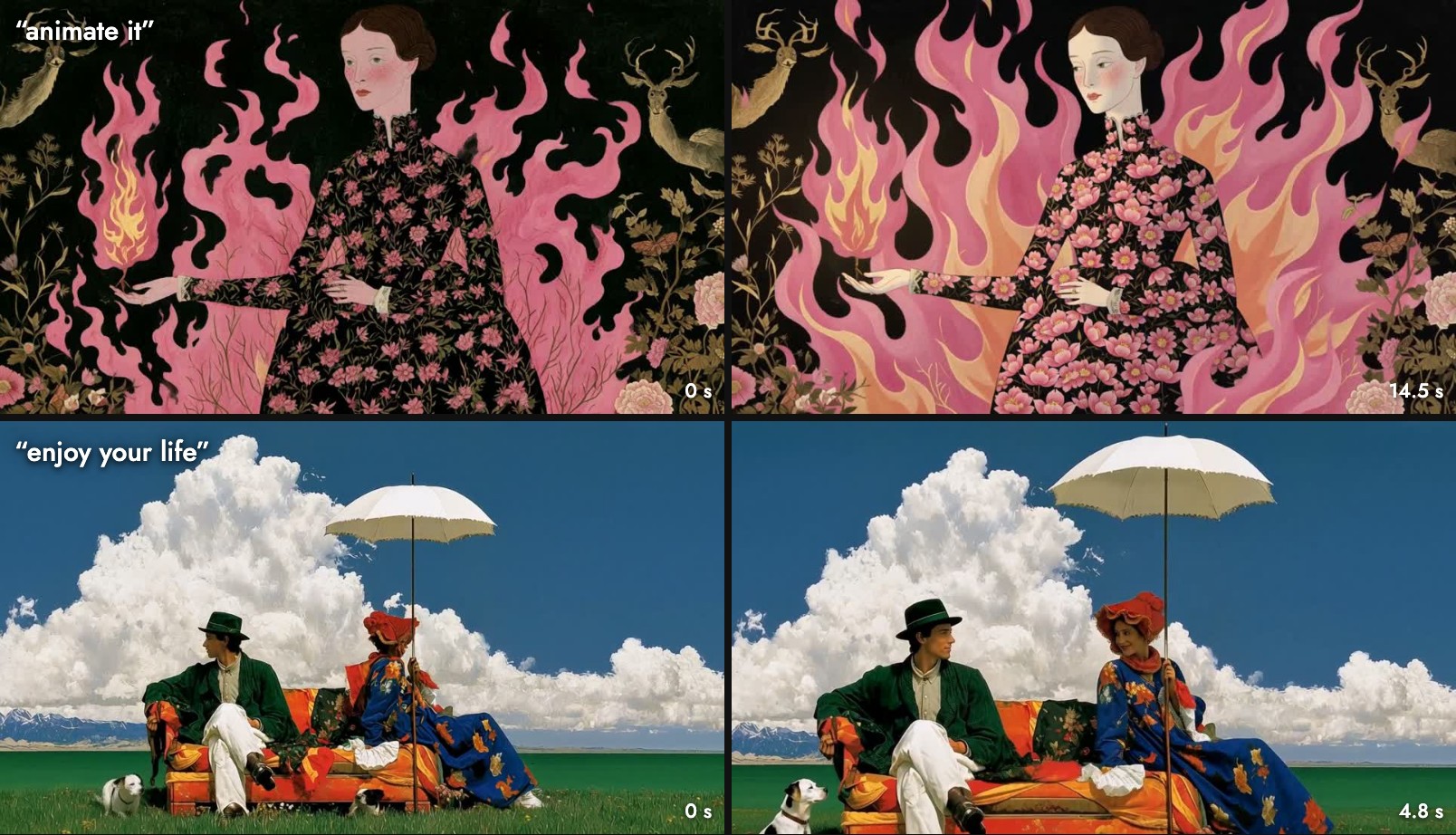
With nothing to act on, H3 Max barely moved: the flames flicker, the umbrella sways, the people stay put. That is useful when you want a living still, and a waste of 15 seconds when you wanted a scene.
What it costs and how long it takes
| Length | 480p | 768p | 2K |
|---|---|---|---|
| 5 s | 20 | 40 | 80 |
| 10 s | 40 | 80 | 160 |
| 15 s | 60 | 120 | 240 |
Credits on Flick. Rates for every model are on model credit costs; a failed generation is refunded (how credits work).
Our timed runs: 16 seconds for 5 seconds at 768p; 2 min 34 s and 2 min 41 s for 5 seconds at 2K; 42 to 52 seconds for five 15 second reference-to-video runs at 768p. Output at 768p is 1344 × 768.
Prompting MiniMax H3 Max
- Write the action, not "animate". A named action produced a full performance; "animate it" produced flicker.
- Expect camera moves. It pushed in on a laugh and cut between angles on the notebook throw without being asked; add "(fixed camera)" if you need it locked.
- Check the style on illustrated frames. It redrew painted flames in a flatter style.
- Know which prompt expansion you ran. Balanced is the default and every test here used it; Quality is the other option in the settings.
- Write sound into the prompt, or rule it out. "no background music" is a valid instruction.
- Motion not what I asked covers the usual fixes.
Errori comuni
- Rendering 2K while exploring. It takes minutes instead of seconds; find the take at 768p.
- Filling 15 seconds with one word. Long clips need a sequence of actions or they stall.
- Assuming it keeps a painted style exactly. Compare the last frame to your start frame.
Sources
- MiniMax H3: An Open Model Breaking the Boundaries Between Tasks and Modalities, MiniMax, July 31, 2026
- MiniMax H3 Max, fal, released August 27, 2026
- Clips, credit rates and timings from Flick canvases, October 2026
Guide correlate
- Generate a video
- Omni Reference
- Motion not what I asked
- Model credit costs
- Choosing a model
- MiniMax H3 Max vs Seedance 2.5
- How to use Wan 3.0
Domande frequenti
What is MiniMax H3 Max?
How much does MiniMax H3 Max cost on Flick? 20 credits for 5 seconds at 480p, 40 at 768p and 80 at 2K, up to 240 for 15 seconds at 2K.
How much does MiniMax H3 Max cost on Flick?
How fast is it? Our 5 second 768p run took 16 seconds. 2K took about 2.5 minutes.
How fast is it?
Is it on the Free plan? Yes, on every plan.
Is it on the Free plan?
MiniMax H3 Max or Seedance 2.5? H3 Max for fast, cheap takes up to 15 seconds; Seedance 2.5 for longer clips and more elaborate direction. See our comparison.