How to Use Eleven v4 in 2026: Dialogue, Audio Tags and Pricing
Oct 2026
Eleven v4 is ElevenLabs' newest text-to-speech model, released on September 28, 2026. On Flick it runs in the Text to Voice node: you pick a library voice for each speaker, type their lines, and steer the delivery with audio tags such as [whispers] or [laughs]. It costs 8 credits a take.
In our three-model voice test it came second for emotion, behind Seed Audio 1.0 and ahead of Eleven v3, and it gave the tightest timing of the three.
Quick answer: how do you use Eleven v4?
Click + on the left toolbar, choose Generate Voice, and pick Eleven v4. Then:
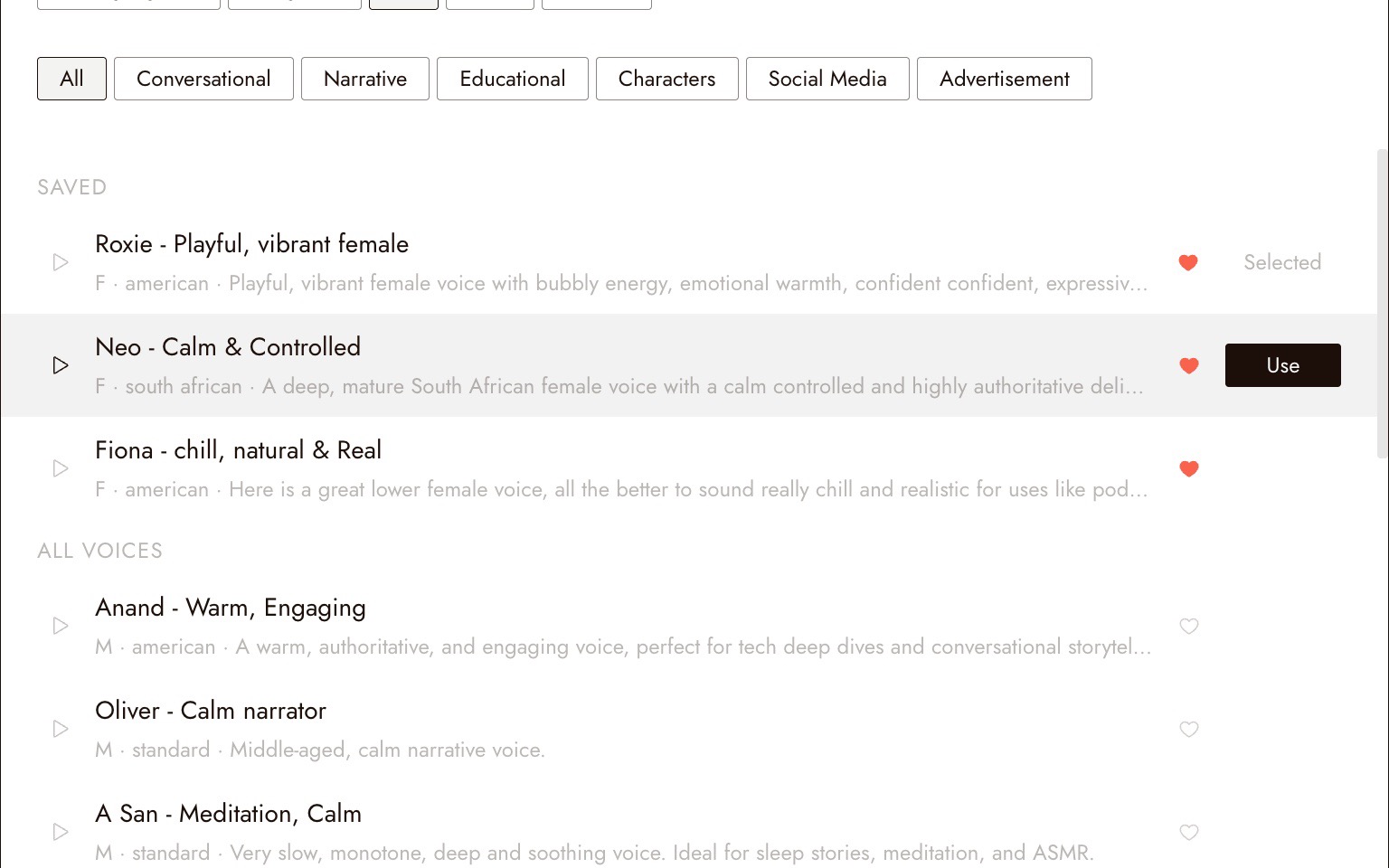
- Pick a voice for Speaker 1. Click Select voice, hover to preview, click Use.
- Type the line, with tags for delivery. [short pause] and [nervous laugh] both showed up in our take.
- Add speakers and run for 8 credits. Up to 10 speakers in one take.
| Spec | Eleven v4 on Flick |
|---|---|
| Maker | ElevenLabs |
| Released | September 28, 2026 |
| Price on Flick | 8 credits per take, any length |
| Plans | Every plan, including Free |
| Speakers per take | Up to 10, one library voice each |
| Languages (ElevenLabs) | 90+ |
| Text per request (ElevenLabs) | 10,000 characters |
| Settings | Stability, 0 to 1 (default 0.5) |
| Output we got | MP3, 44.1 kHz mono |
| Our takes | 6.8 s and 7.2 s long; 90 s and 73 s to finish |
Voice your scene with Eleven v4
One library voice per character, tags for delivery, 8 credits a take.
What Eleven v4 is
ElevenLabs calls Eleven v4 its most expressive model and the first of a new generation, and recommends it over Eleven v3. Compared with v3 it lists more languages (90+ against 70+) and twice the text per request (10,000 characters against 5,000). ElevenLabs also says v4 ranked first in Artificial Analysis's voice arena; that is the company's claim, not our test.
A faster sibling, Eleven v4 Turbo, is aimed at real-time agents. Flick runs Eleven v4.
Test 1: a two-person dialogue
Two library voices, Neo (calm, South African) and Roxie (playful, American), one line each:
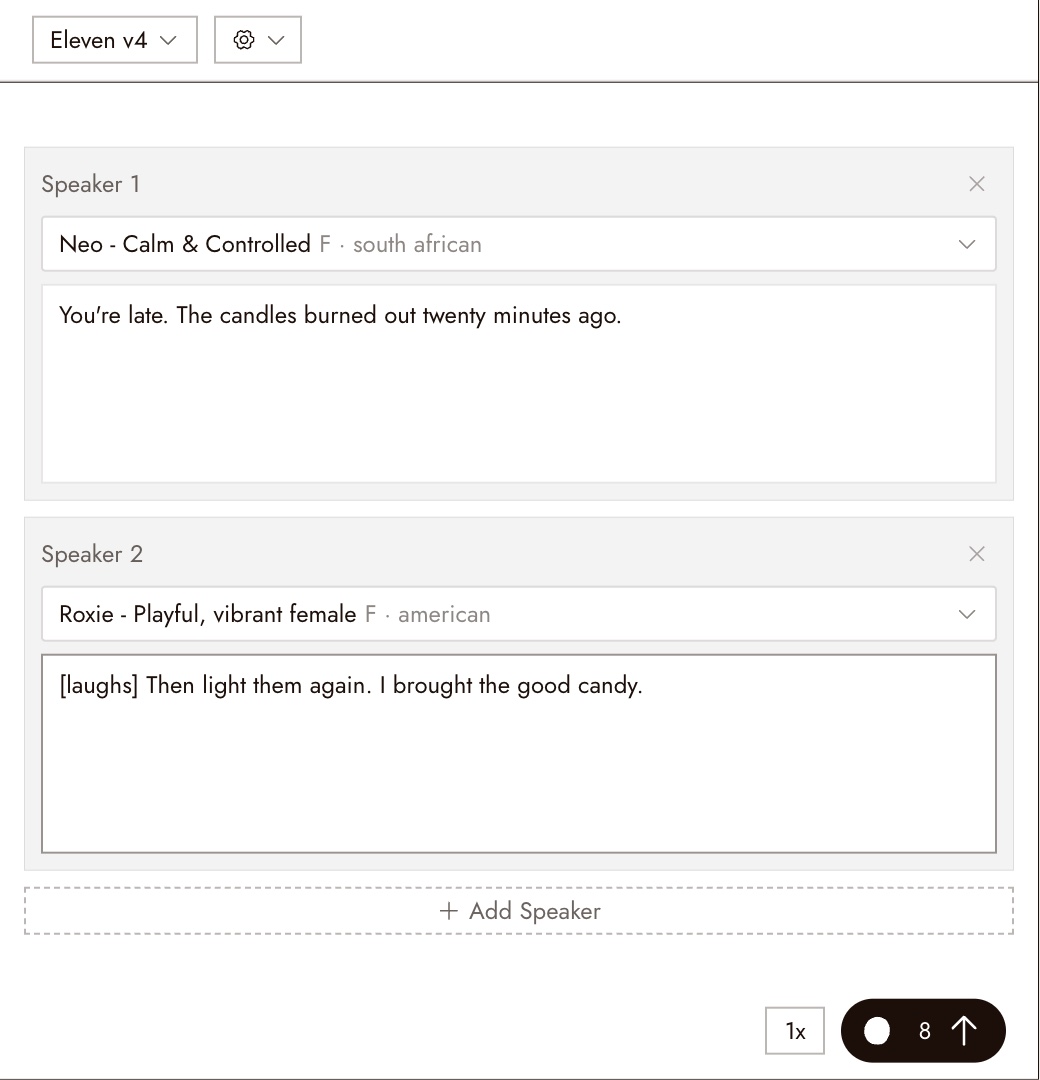
The take is 6.8 seconds, the second speaker comes in at 3.4 seconds, and every word came back as written. That is the tightest of the three models we tested; Seed Audio stretched the same lines to 10.8 seconds.
Test 2: what audio tags do
One speaker, three tags in one line:
[whispers] Did you hear that? [short pause] Something is moving behind the gate. [nervous laugh] It's probably just the wind.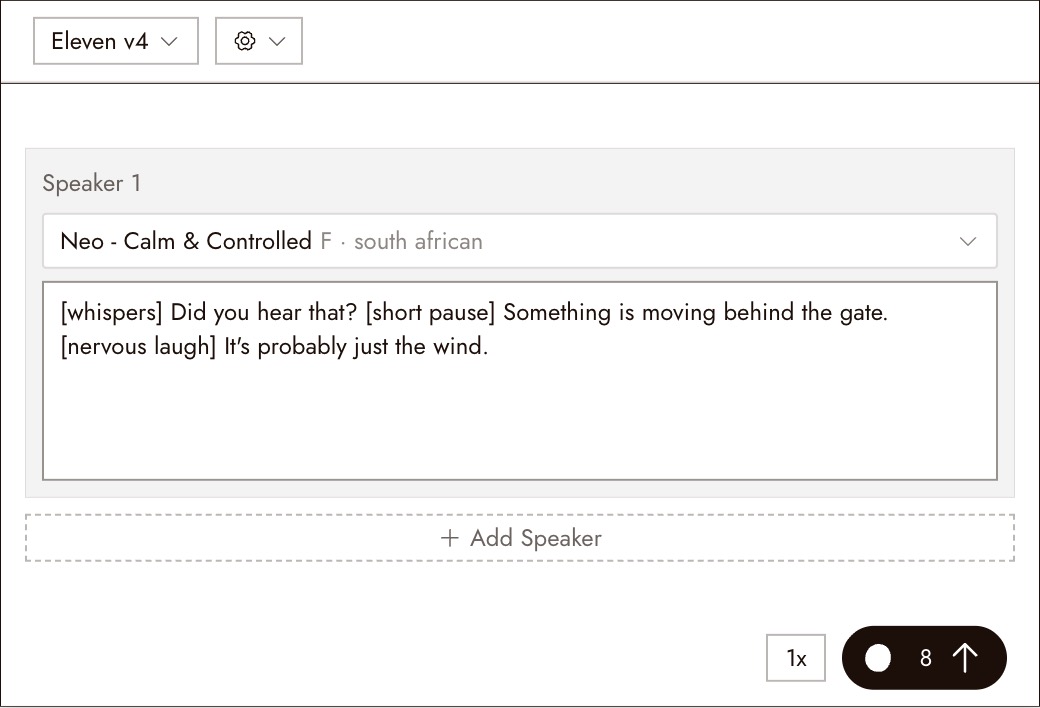
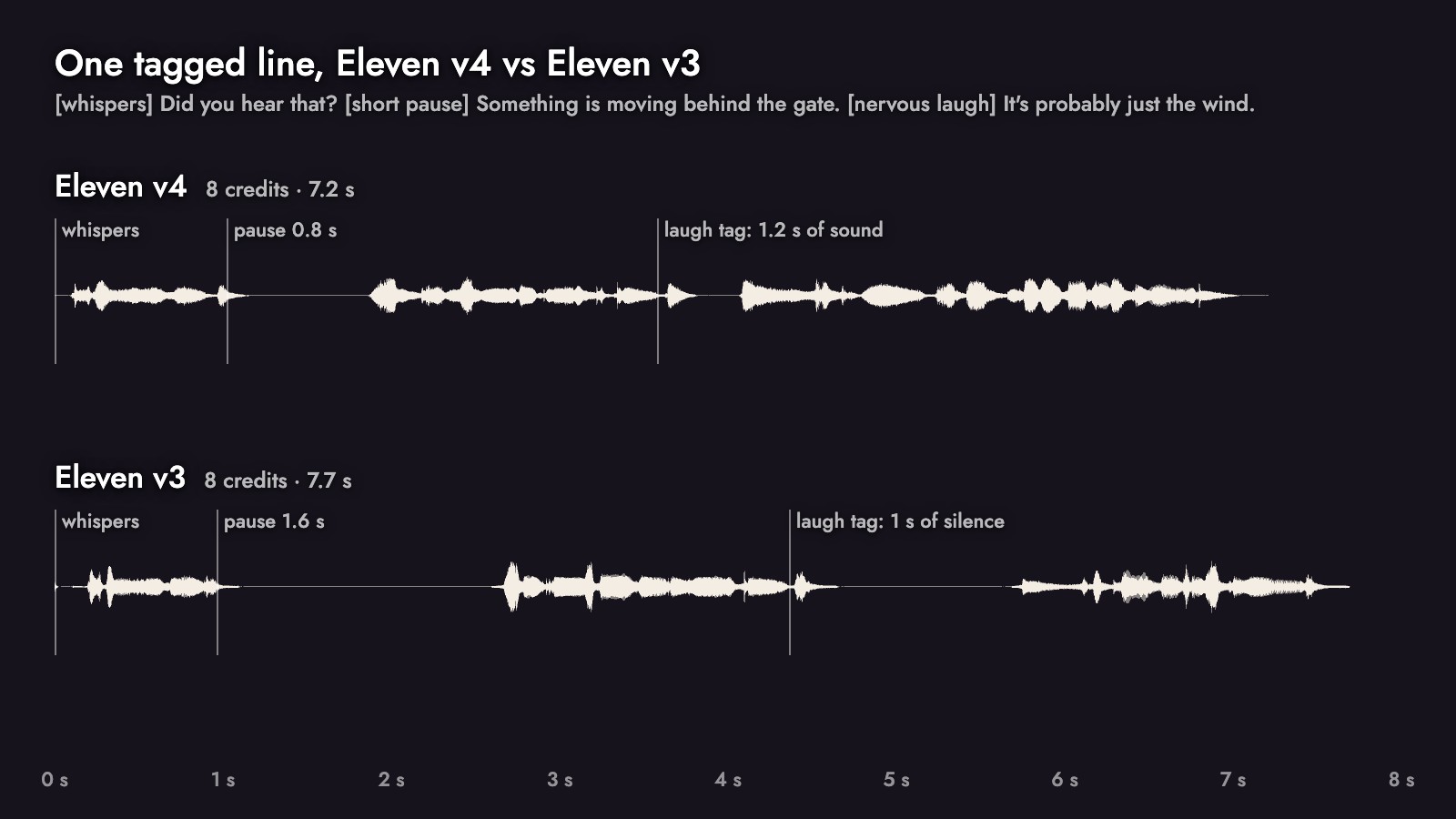
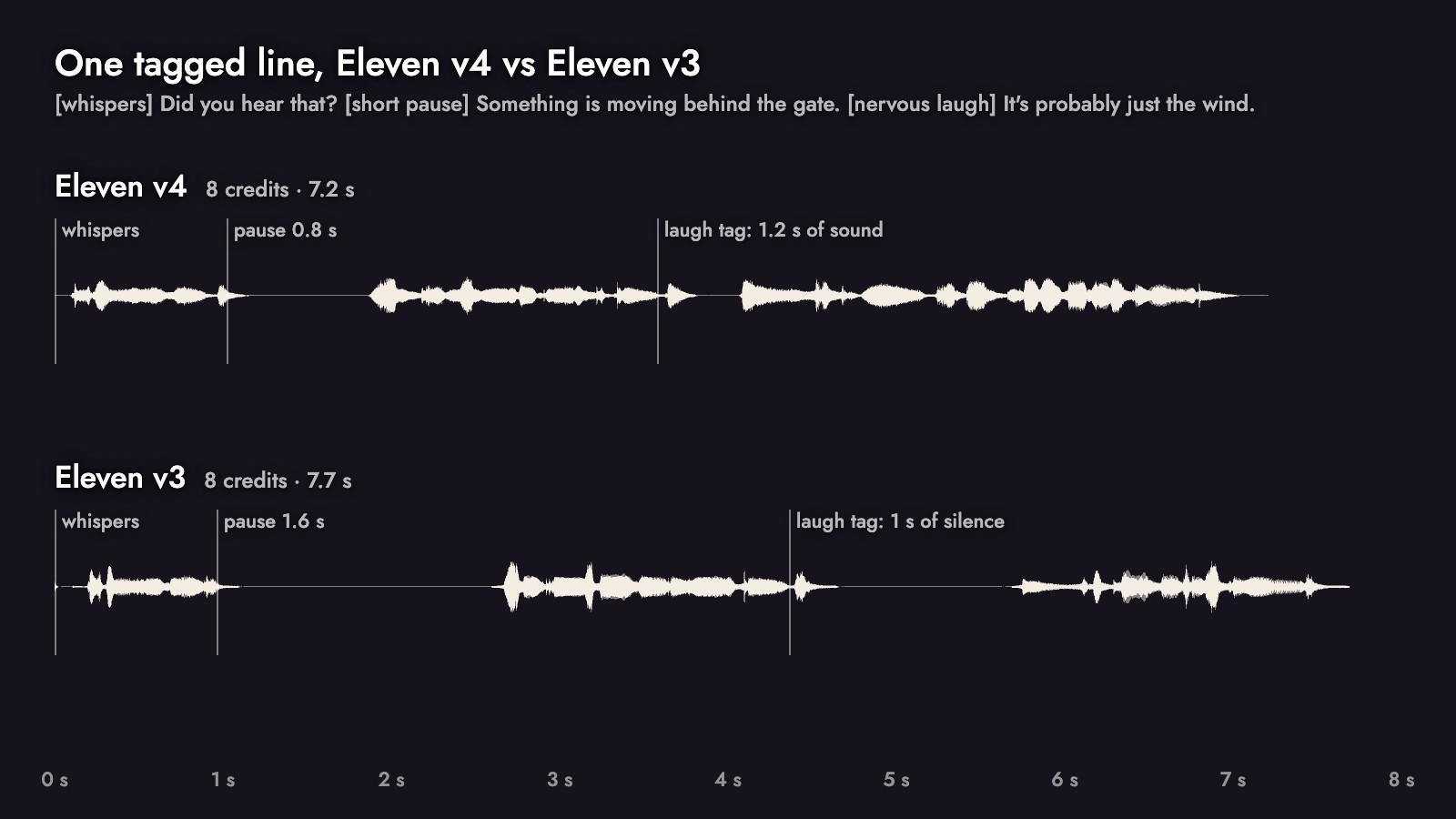
We measured the take rather than describe it:
- [whispers]: applied to the opening question. A whisper is about breath, not volume, and the opening measures about as loud as the next sentence, so judge this one by ear.
- [short pause]: 0.8 seconds of silence after "that?".
- [nervous laugh]: about 1.2 seconds of sound before "It's probably just the wind".
- No tag was read aloud as a word.
The same line on Eleven v3 left a second of silence where the laugh should have been. More on that in our Eleven v3 guide.
What it costs and how long it takes
Eleven v4 is a flat 8 credits per take on every plan, the same as Eleven v3 and a third of Seed Audio 1.0's 25. On Casual's 500 monthly credits that is 62 takes. Rates for every model are on model credit costs; a failed generation is refunded (how credits work).
Our two runs took 90 and 73 seconds from Run to finished file. The files measured -28.0 and -25.8 LUFS.
Writing for Eleven v4
- Write lines the way they are spoken. Short sentences, punctuation for pauses.
- Use tags, not SSML. ElevenLabs says v4 does not support SSML break tags; use [short pause], punctuation and line breaks instead.
- Pick tags the voice can do. ElevenLabs notes tags work best when the delivery is in the voice's range; a calm narrator voice may not shout well.
- Describe voice quality when a tag could be heard as a sound. ElevenLabs suggests [low, gravelly voice] over a tag that might be played as an effect.
- Save the voices you reuse with the heart in the voice picker, so each character keeps one voice. See voice consistency.
Errori comuni
- Using SSML break tags. v4 ignores them; use [short pause] or punctuation.
- Stacking many tags in one sentence. Three in our line worked; give each tag its own phrase.
- Changing voices between clips. Keep one saved voice per character.
- Mixing v4 with v3 or Seed Audio takes without levelling. Our v3 dialogue ran about 12 dB hotter than v4.
Sources
- Introducing Eleven v4, ElevenLabs, September 28, 2026
- Models, ElevenLabs documentation, checked October 21, 2026
- Prompting Eleven v4, ElevenLabs documentation, checked October 21, 2026
- Tests, credit prices, timings and measurements from a Flick canvas, October 2026
Guide correlate
- Text to Voice
- Voice consistency
- Character Dialogue
- Build the sound
- Model credit costs
- Eleven v4 vs Eleven v3 vs Seed Audio 1.0
- How to use Eleven v3
Domande frequenti
What is Eleven v4?
How much does Eleven v4 cost on Flick? 8 credits per take, whatever the length.
How much does Eleven v4 cost on Flick?
Is Eleven v4 better than Eleven v3? In our test it was more expressive, honoured a laugh tag that v3 skipped, and ElevenLabs recommends it over v3.
Is Eleven v4 better than Eleven v3?
How many speakers can Eleven v4 do? Up to 10 per take on Flick, each with its own library voice.
How many speakers can Eleven v4 do?
Does Eleven v4 support SSML? Not break tags, according to ElevenLabs. Use audio tags and punctuation for timing.
Does Eleven v4 support SSML?
Eleven v4 or Seed Audio 1.0? Seed Audio for the most emotional read and scene sound, at 25 credits. Eleven v4 for chosen library voices, tight timing and 8 credits.