
Dutch Angle in AI Video: Prompts and Examples

A Dutch angle is a shot with the camera rolled to one side, so the horizon runs at a slant and the scene feels uneasy.

An ink drawing of an old film camera on a tripod, leaning sharply to one side
An astronaut hauls herself along a diagonal rail in a spaceship corridor under pulsing red alarm lights00:05
A Dutch angle at 25 degrees: the corridor stays tilted from the first frame to the last.Seedance 2.5

To get a Dutch angle in AI video, name the degrees of tilt in the start frame and tell the video model never to level out. We found 25 prompts that ask for one in the 4,069 video prompts behind 67 Flick team and residency films, then tested the wording ourselves.

What does a Dutch angle look like in AI video?

It looks like the world has slipped: in each of our tests the frame was still tilted in the last second, because the angle was written into both prompts.

Each shot here, and the spaceship at the top of this page, started from a GPT Image 2.5 frame with the tilt in its prompt, then went to Seedance 2.5 with no sound.

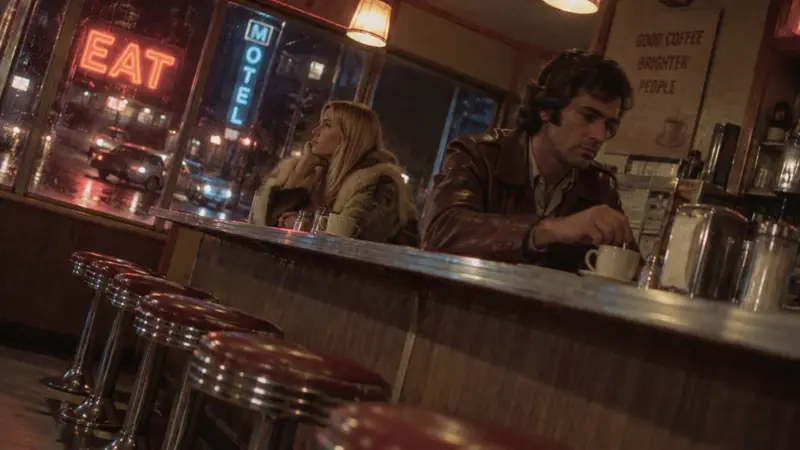
A man and a woman ignore each other at a neon-lit diner counter, the counter and stools running diagonally00:05

A small lean for a quiet argument, at 15 degrees

The counter gives the eye one long straight line to measure against, so even this gentle tilt reads clearly.

Keep the whole frame tilted 15 degrees counterclockwise for the entire shot, never levelling out. The man sets his cup down without looking at her, and she turns her head slowly toward the window. The neon flickers. Camera holds still.

A captain in yellow oilskins grips a slanted railing as a grey wave rises behind a steep tilted horizon00:05

A storm at sea, at 30 degrees

The steepest tilt in our tests still reads as a real horizon, because the sea and the railing give the slant away.

Keep the horizon tilted 30 degrees clockwise for the entire shot, never levelling out. The deck heaves, a wave breaks over the railing and the captain braces against the spray. Slight handheld sway.
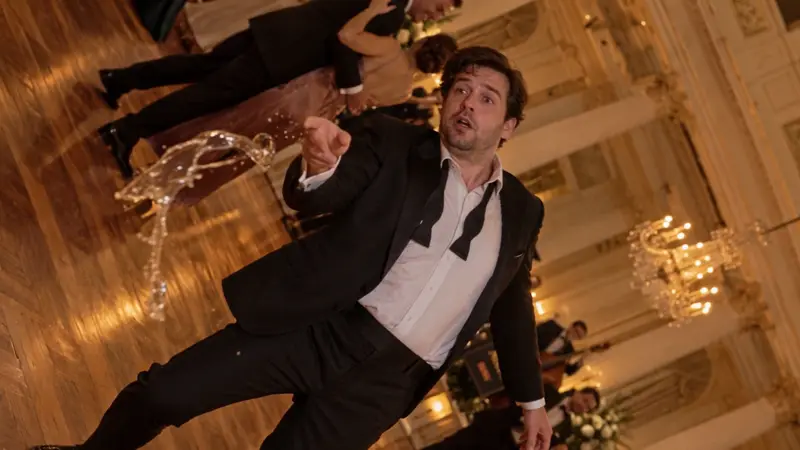
A wedding guest in a loose bow tie staggers, spilling champagne, as the ballroom rolls steeply behind him00:05

A roll that grows, from 20 to 40 degrees

A tilt that keeps growing plays as comedy here, with the room falling away at the speed the guest loses his balance.

The camera slowly rolls clockwise as the guest loses his balance, the tilt growing from 20 degrees to 40 degrees by the end of the shot, the chandelier and columns leaning further. Champagne spills from his glass. The couples keep dancing.
Two anime schoolgirls face each other on a rooftop at sunset, the fence and skyline tilted diagonally00:05

A standoff in 2D anime, at 25 degrees

Tilt works the same in drawn styles, and a chain-link fence and a skyline supply the lines that make it visible.

Hand-drawn 2D anime. Keep the whole frame tilted 25 degrees counterclockwise for the entire shot, never levelling out. Wind blows both girls' hair and skirts, the girl in the distance clenches her fist, clouds drift across the sunset. Camera holds still.

How do filmmakers use a Dutch angle in real AI films?

They use it sparingly, for a single beat inside a longer scene, and they write it into the shot description next to the lens and the action.
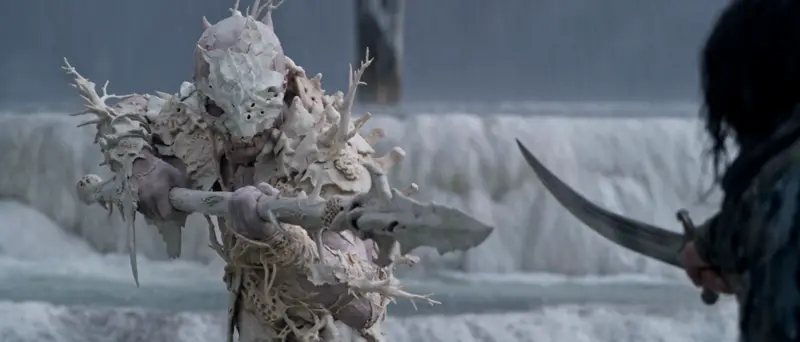
Two fighters circle each other on a frozen lake among bare trees in grey light, the frame slightly tilted00:30

A controlled lean inside a fight

The prompt asks for a Wide full-body two-shot with a controlled Dutch angle., which keeps both fighters readable while the fight feels unstable.

Jaime Yao, director of In ’twixt Vows

A dark curved blade grows from a monster's arm, in a tilted low-angle close-up through blue haze00:10

A low angle on the blade

One shot in a multi-shot prompt pairs a low camera, a 24mm lens and a Dutch angle, so the threat feels close as the blade appears.

Alan Xiao, director of Tusk Hunters

A painted girl in a white dress falls through an empty grey space, tilted, with a small figure far behind her00:05

A fall in painted 2D

A hand-drawn film asks for a shot that is Camera tilted, off-center., and with no horizon at all the girl's tilted body becomes the line we read.

Walter Mauro, director of Duro

A woman with blonde hair glances back over her shoulder beside a bar table in a dim lounge, the frame tilted00:05

A slow reveal, tilted the whole way

Here the canted angle lasts the entire shot as the camera rises to her face, so the unease builds before we see her expression.

Gertywood, director of Xenogenesis

What is a Dutch angle?

A Dutch angle, also called a Dutch tilt or a canted angle, is a shot where the camera rolls on its lens axis, so straight lines in the scene lean instead of sitting level.

The shot is closely tied to German Expressionist cinema of the 1920s, and Wikipedia's entry on the Dutch angle lists it under several other names, including the German angle. It is different from a camera tilt, which points the lens up or down while the horizon stays level.

What a Dutch angle can say, and the test shot on this page that shows it
FeelingWhy the tilt helpsTilt we usedExample
Something unspokenA small lean is felt before it is noticed15 degreesThe diner
DangerNothing in the frame offers a level place to rest25 degreesThe astronaut
ChaosA steep horizon adds to the movement in the shot30 degreesThe storm
Losing balanceA growing roll puts the audience inside the character's head20 to 40 degreesThe wedding guest

A Dutch angle prompt to copy

Use the first line in your image prompt to build the tilt into the start frame, then the second in your video prompt to keep it there.

For the start frame

Dutch angle, the whole frame tilted 25 degrees clockwise so the walls and floor lines run diagonally.

For the video

Keep the whole frame tilted 25 degrees clockwise for the entire shot, never levelling out.

How do you keep a Dutch angle from levelling out?

Put the tilt in the start frame, give it a number and a direction, and include straight lines, because a video model keeps the slant it can see.
  1. 1. Start from a tilted frame

    Every test shot on this page began from a frame that was already tilted, so the video had to keep a slant that was already there.

  2. 2. Give a number and a direction

    Writing 25 degrees clockwise leaves the model less room than the word tilted, and it lets you match the same lean across several shots in a scene.

  3. 3. Show straight lines

    A tilt needs something to lean, so choose a horizon, a counter, a door frame or a fence, because soft backgrounds hide the angle.

  4. 4. Keep it for one beat

    A slant holds attention because the rest of the film is level, so save it for the moment when something has gone wrong.

    Wide full-body two-shot with a controlled Dutch angle.
    Jaime Yao, director of In ’twixt Vows

How do you make a Dutch angle in Flick?

Decide what the tilt should say, generate a tilted start frame, animate it with a prompt that holds the angle, then check the last frame before you cut it in.
A crime boss in a white suit behind a desk, blind shadows slanting across the wall, black and white, tilted
A start frame with the tilt in its prompt: low camera, 20 degrees counterclockwise.GPT Image 2.5
  1. 1Choose the feeling

    Pick one feeling for the shot, then choose the tilt to match it: about 15 degrees for quiet unease, about 25 for threat and 30 or more for chaos.

  2. 2Generate the start frame

    Open the prompt with Dutch angle, give the degrees and the direction, and describe the lines that should run diagonally, so the slant is built into the picture.

  3. 3Animate and hold it

    Use the frame as the video's start image and write that the frame stays tilted for the entire shot, then describe one action and any camera move.

  4. 4Check the last frame

    Watch to the end of the clip, because a shot that levels out in its final second will not cut against the next one the way you planned.

Dutch angle questions

What is a Dutch angle in film?

A Dutch angle is a shot where the camera is rolled to one side, so the horizon and other straight lines slant across the frame. Filmmakers use it to make a scene feel tense, unstable or wrong.

Why is it called a Dutch angle?

The origin of the name is debated. A common explanation is that "Dutch" comes from "Deutsch", the German word for German, since the shot became prominent in German Expressionist films, and it has also been called the German angle.

What is the difference between a Dutch angle and a canted angle?

There is no difference: Dutch angle, Dutch tilt, canted angle and oblique angle are names for the same shot. A camera tilt is something else, since it points the lens up or down and keeps the horizon level.

When should you use a Dutch angle?

Use a Dutch angle for a moment when something is off, such as a threat arriving, a character losing control or a quiet argument. It works best when most of the film is level, because too many tilted shots lose their effect.

How many degrees is a Dutch angle?

There is no fixed number. In our tests, 15 degrees read as a slight lean and 30 degrees as a steep, stormy slant, and 25 degrees was a clear tilt that still left the scene easy to follow.

How do you prompt a Dutch angle in AI video?

Write the angle, the degrees and the direction in the image prompt, such as "Dutch angle, the whole frame tilted 25 degrees clockwise", then tell the video model to keep the frame tilted for the entire shot and never level out.

Can a Dutch angle work in animation?

Yes. A Dutch angle works in any style because it depends on lines in the frame, not on a real camera. On this page it appears in a 2D anime test and in Duro, a hand-painted film.

More on directing shots in Flick

Films on this page

Tilt your next shot in Flick

Write the angle into your start frame, keep it in your video prompt and cut the shot into your film on one canvas.

Try a Dutch angle in Flick

Try for free, no credit card required.

Ask AI about this page:ChatGPTPerplexityClaude