KI-Generator für Dark Fantasy Art

Erstelle Dark Fantasy Art und Clips aus einem Prompt: verfluchte Ritter, verfallene Kathedralen, ertrunkene Wälder und Kreaturen im Nebel, gemalt in Schatten und Kerzenlicht. Kostenlos ausprobieren.

Was ist Dark Fantasy Art?

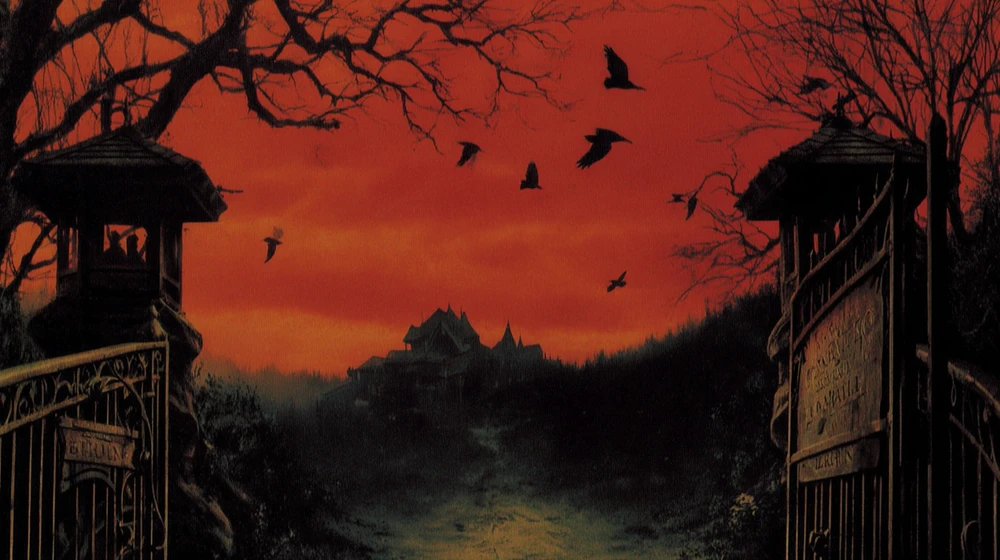
Animated dark fantasy painting of a knight in a red cloak walking toward a ruined cathedral glowing green as ravens circle
Erster Frame: Animated dark fantasy painting of a knight in a red cloak walking toward a ruined cathedral glowing green as ravens circle
Erster Frame
00:05

Dark Fantasy Art ist Fantasy gemalt in düsterer, gotischer Stimmung: Ritter, die verloren haben, Königreiche in Ruinen, Hexen, Monster und Wälder, die Reisende verschlingen, in tiefen Schatten mit einem kalten oder warmen Licht. Dies von Hand zu erstellen kostet einen Maler Wochen pro Szene; in Flick beschreibst du die Welt, wählst einen Dark Fantasy Stil und generierst, dann verwandelst du das Standbild in einen bewegten Clip auf demselben Canvas. Die Beispiele unten stammen aus In 'twixt Vows, einem Residency-Film in Flick erstellt, und aus Bildern, die für diese Seite mit GPT Image 2.6 erstellt wurden, jeweils mit dem genauen Prompt darunter.

Wie erstellt man Dark Fantasy Art mit KI?

In drei Schritten: Beschreibe die Szene mit ihrem Licht, Verfall und einer fokalen Figur, wähle einen Dark Fantasy Stil, dann baue die Clips darum herum auf einem Canvas.
  1. Schritt 1

    Beschreibe die Szene.

    Gib der Szene eine Figur, eine Ruine und eine Lichtquelle: hier ein einsamer Ritter, eine Kathedrale, die kränklich grün leuchtet, und Raben im Nebel, gemalt in schwerem Chiaroscuro, damit die Stimmung düster statt heroisch bleibt.

    Knight in a torn red cloak at the edge of a dead forest facing a ruined gothic cathedral glowing green, ravens circling
    Dark fantasy art, painted like a moody oil painting with heavy chiaroscuro. A lone knight in battered blackened armour and a torn crimson cloak stands at the edge of a dead forest, facing a ruined gothic cathedral on a hill whose broken windows glow a sickly green from within. Twisted leafless trees with branches like claws, ravens circling the spire, low fog over the ground, a pale sickle moon behind thick clouds. Muted palette of charcoal, bone and dried-blood red, with one cold green light source. Grim, ominous and beautiful. No text, no signature.
    Bedeutung:Ein einsamer Ritter in schwarzer Rüstung steht vor einer Ruine mit giftgrünem Licht im düsteren Wald wie ein dunkles Ölgemälde.
  2. Schritt 2

    Wähle den Stil.

    Wähle einen Dark-Fantasy-Stil einmal aus und jedes Bild erbt sein Licht, seine Palette und seinen Pinselstrich, von nebligem Realismus bis zur klassischen Ölmalerei; jeder öffnet sich in Flickpedia.

  3. Schritt 3

    Baue den ganzen Kurzfilm.

    Verwandle jedes Standbild in einen Clip und verbinde jede Einstellung mit den Kreaturen- und Ortschafts-Referenzen, aus denen sie entstanden ist, damit eine verfluchte Welt sich durch den Film zieht; dies ist Teil des Canvas hinter In 'twixt Vows, Jaime Yaos Dark Fantasy aus ertrunkenen Wäldern, Sumpfkreaturen und gepanzerten Reitern.

    In ’twixt Vows von Jaime Yao

    Ziehen zum Umsehen, scrollen zum Zoomen.

    Film und kompletten Workflow ansehen

Dark-Fantasy-Kunst, gemacht mit Flick

Reiter unter riesigen Wurzeln, ertrunkene Wälder, eine ausgehungerte Waldbestie, ein Knochenthron und ein verfluchtes Dorf, jeweils aus einem einzigen geschriebenen Prompt gemacht.
Gepanzerter Reiter, der unter den gewölbten Wurzeln einer berggroßen Buche in einem nebligen Wald galoppiert

Ein Reiter unter kolossalen Wurzeln

Die Größenverhältnisse erledigen hier die Arbeit: ein kleiner Reiter unter Wurzeln so groß wie eine Kathedrale lässt die Welt uralt und feindselig wirken.
A warrior in Byzantine-style lamellar armor, worn, tattered, and heavily weathered, is riding at full gallop beneath the roots of an ancient common beech tree so enormous that it feels mountain-sized.

The camera is a low tracking shot.
The camera sits very low near the ground, behind and slightly below the rider, looking slightly upward.
The view follows the rider charging forward.
The rider and horse sit near the lower middle area of the frame, not large, but clearly readable.
A massive section of root fills the entire overhead space like a natural vaulted ceiling.
On the left and right sides of the frame, additional colossal roots or root-like supporting forms are visible, creating enclosure and pressure.
The composition should first read as a rider and horse racing forward, and then reveal that the overhead and surrounding space is formed by impossibly huge ancient beech roots.

The scale of the beech tree is extreme.
The overhead root and the flanking root structures are not normal roots, but gigantic organic forms with the scale of monumental pillars and mountain-like arcades.
Their material should read as real European beech bark and wood fiber.
The surface palette is mainly pale gray, silver-gray, cool gray-brown, and touches of muted pale brown-gray.
Show broad areas of relatively smooth but not perfectly flat beech bark, visible wood grain and fiber direction running with the form, shallow vertical folds, occasional burl-like swellings, a few torn and curling bark edges, blunted weathered edges, and darker damp wooden areas.
Near the ground, the roots become rougher, with accumulated dust, mud staining, damp marks, moss, and lichen attachment.
The whole root system should feel ancient, living, naturally grown, extremely heavy, and vastly beyond normal scale.

The ground vegetation is based on Pyrenean mountain valley and forest-edge vegetation.
The surface is covered with broad mountain grassland made mainly of fine tufted fescue-like grasses, thin bent-grass-like strands, low sedges, and irregular grass clumps.
Many low shrubs are scattered throughout, mainly juniper shrubs, heather, bilberry-like low shrubs, broom, boxwood, and small patches of low mat-forming heath.
Some pale gray-brown soil, stones, pale exposed roots, and hoof-pressed grass traces are visible between the vegetation.
Along the background edges, include a few silhouettes of young beech, young fir, and scattered mountain pine.
Keep the colors within restrained dark gray-green, gray olive-green, cool grass green, dry yellow-green, brown-green, and some darker deep cypress green.
The grass and shrubs should break into natural irregular patches, with a slight wind-pressed mountain feel.

The rider wears standard Byzantine-style lamellar armor, but the whole outfit is worn, damaged, and weather-beaten.
The armor is made of many small metal lamellae covering the shoulders, chest, and torso.
The metal plates read as cool gray iron and deep gray steel, with worn edges, slight oxidation darkening, fine scratches, mud traces, and uneven natural reflections.
The underlayers, cloth elements, and soft protective garments read as deep brown, smoke-brown, gray-black, and aged fabric tones, with tearing, fraying, staining, damp marks, and real use wear.
Belts, boots, and tack are made of aged dark brown leather, with creases, abrasion, stretched deformation, and dirt.
The figure should not read like a posed character design sheet, but like a real warrior in motion, fleeing or charging through the landscape.
The rider remains scaled to the wide environmental shot rather than enlarged into close-up detail.

The horse is in a fast gallop.
Its posture drives forward, with a forward-leaning center of motion and readable running rhythm in the legs.
The mane and tail are lifted by speed.
The tack is deep brown aged leather with dark metal fittings, physically real, worn, and marked by damp dust.

The overall lighting is natural daylight filtered through cold damp mist.
The main ambient light comes from a gray-white sky diffused through fog, with an overall cool gray-blue cast.
Ahead in the distance, a brighter white-gray opening between the roots lets light through, gently illuminating the ground in the rider’s path, the outline of the horse, and the lower edge of the overhead root.
The underside of the roots overhead, the inner sides of the flanking roots, and the deeper spaces fall into darker cool-gray shadow.
Transitions between bright and dark are established naturally through fog and humid air rather than hard contrast.
The air contains a clear layer of cold damp mist, slightly clearer nearby and progressively denser in the farther roots and background vegetation.
The depth structure must read clearly: foreground grass, the rider and horse in the midground, the nearest overhead root, the more distant flanking roots, and finally the misty background slopes and trees.

Use real cinematic optical rendering.
The shot is a low-angle upward-looking tracking view.
Use the natural compression of a medium-long to long lens.
Use moderate depth of field.
Focus sits primarily on the rider, the horse, and a short stretch of ground directly ahead of them.
The nearest lower edge of the overhead root remains clearly readable.
The more distant side roots and the background slope are naturally softened by distance and humid mist.
A narrow strip of the closest foreground grass and shrubs along the bottom edge is slightly out of focus.
In this strip, grass blades and shrub edges soften and open gently, with fine detail slightly relaxed and tonal transitions smooth and natural.
This softness comes from real optical defocus.
The distant softness comes from real atmospheric perspective and natural optical rendering rather than flat digital blur.

Subtle film grain.
Slight chromatic aberration.
Slight sensor noise.
Mild lens softness.
Restrained soft bloom in the brighter fog zones.
Slightly uneven natural exposure.
Natural imperfect real-camera rendering.
Realistic beech bark, weathered wood fiber, Pyrenean grassland, juniper shrubs, broom, bilberry, boxwood, Byzantine lamellar armor, aged leather, horse tack, cold mist, and damp ground textures.
In ’twixt Vows, Regie: Jaime Yao
Bedeutung:Ein byzantinischer Krieger reitet im vollen Galopp unter riesigen uralten Buchenwurzeln hindurch, filmisch mit kaltem Nebel und Pyrenäenvegetation gerendert.
Dunkler überfluteter Wald aus geschwollenen Stämmen, schwarzem Wasser und hängendem Moos unter grauem Licht

Ein ertrunkener Wald

Ein leerer Ort mit schwarzem Wasser, Fäulnis und hängendem Moos erzeugt das Grauen, bevor überhaupt eine Kreatur erscheint.
Pure environment, live-action static film frame.
No people.
No animals.

The camera is positioned inside the flooded wetland forest at approximately adult eye level, looking slightly forward and slightly downward into a narrow water channel and layered tree space.
Use an approximately 24–28mm wide-angle lens with realistic perspective, mild natural edge stretching, and believable optical lens behavior.

Ahead lies an ancient wetland forest that has been submerged in black water for centuries.
Massive wetland trunks, swollen root bases, exposed roots, rotten wood, broken stumps, and black water form a narrow, fragmented, oppressive local space.
Large amounts of Spanish-moss-like hanging epiphytic growth descend from high branches, side branches, and forked limbs, creating tangled vertical, diagonal, and horizontal fibrous structures throughout the forest.

The main visual anchor is a group of hanging epiphytic masses in the midground that create a disturbing human-like silhouette illusion.
These forms are not floating in open air.
Each one is clearly attached at the top to a visible overhead branch, bent side branch, or branch fork, and hangs downward under gravity as dense draped fibrous growth.
The upper attachment points remain readable.
The hanging masses are long, uneven, wet, and ragged, with narrower upper portions and broader, more tattered lower portions, creating the impression of head-like and torso-like shapes with trailing lower strands.
One central hanging mass should be the clearest and largest, positioned near the center of the frame.
One or two additional hanging masses appear deeper behind it at slightly different heights and distances, also attached to branches and partly obscured by fog.

These human-like silhouettes must read as natural masses of hanging epiphytic vegetation only.
They are formed by heavy draped moss-like growth hanging from branches, with irregular split lower ends and dense wet fibrous texture.
They remain motionless and integrated into the forest structure.

The black fog is the other major subject.
It is not a small isolated patch or a thin drifting cloud.
It is a dense, heavy, low-luminance mass that occupies a large volume of the midground and background, spreading laterally between the trunks and filling much of the space above the water.
It gathers thickly across the deeper forest and swallows a large amount of distant visual information.
Many distant trunks are partly buried in it.
Large portions of the deeper forest are veiled or completely lost inside it.
The fog creates a strong sense that the space behind the midground is being consumed and erased.

The fog should feel like deep black-gray and charcoal-black wet obscurity rather than bright mist.
It is dense enough that visibility drops quickly after the first few layers of trunks.
Farther roots, low branches, and hanging growth disappear into it.
Only partial silhouettes and broken vertical fragments of deeper trunks survive through the haze.
The fog mass should visually cover and bury much of the far forest instead of leaving the distant background clean and open.

Ground and water structure remain sparse, cold, and broken.
Black water is the dominant ground element, with only small wetland grasses, scattered floating leaves, sparse duckweed, broken algae film, and occasional exposed root fragments.
The water surface reads as near-black with only a few restrained broken cold reflections.

Several near-lens branches, thin roots, and hanging epiphytes enter close to the frame edges.
These foreground elements are strongly but naturally defocused, partially obscuring the view while leaving a readable window toward the central hanging forms and the fog-filled channel behind them.

Focus rests loosely on the clearest central hanging epiphytic mass and the nearby midground trunks.
Very close foreground branches fall into natural optical defocus.
The attached hanging masses behind the first one progressively lose edge definition as they enter the black fog.
The deeper forest rapidly dissolves into obscurity.

There is no visible horizon.
Multiple layers of trunks, roots, hanging vegetation, and black water overlap into the distance before being swallowed by dense black fog.
The deeper background should feel buried, submerged, and visually overwhelmed by the fog volume.

The time is after sunset during deep blue hour, approaching full night.
Only weak residual cold blue-gray skylight diffuses through heavy cloud and the wet atmosphere.
The environment is clearly dark, low-key, enclosed, and oppressive.
The nearest trunks, the clearest hanging human-like moss forms, and a limited area of black water remain readable, while the deeper forest is overtaken by darkness and fog.

Low-saturation palette: near-black water, dark wet brown-black and charcoal bark, cold gray-green hanging vegetation, muted olive-gray aquatic growth, and deep cold blue-gray to charcoal-black fog.

Moderate depth of field with natural optical falloff.
Slight lens softness, subtle film grain, slight sensor noise, restrained chromatic aberration, compressed blacks, natural shadow-detail loss, and imperfect live-action photographic rendering.
In ’twixt Vows, Regie: Jaime Yao
Bedeutung:Eine uralte überflutete Sumpfwaldszene mit menschenähnlichen Moosmassen an Ästen und dichtem schwarzem Nebel bei Dämmerung in düsterer kalter Blautonpalette.
Drei Ansichten eines hageren Waldmonsters mit Geweih, langen Vordergliedmaßen und sichtbaren Rippen vor weißem Hintergrund

Eine ausgehungerte Waldbestie

Die Kreatur zuerst in Vorder-, Seiten- und Rückansichten zu entwerfen, hält dasselbe Monster über jede Einstellung eines Films hinweg konsistent.
Live-action creature three-view presentation on a pure white seamless studio background.
Show the same monster in front view, side view, and back view, arranged side by side at matching scale, with the full body clearly visible in each view. The three views are stable, clean, and easy to read, showing the silhouette, anatomy, and material detail clearly.

Design an extremely gaunt, starved-looking quadrupedal forest predator monster.
Its posture is low and forward-weighted, with a raised spine line, shoulders higher than the hips, and forelimbs clearly longer than the hind limbs, giving the feeling of a dangerous beast ready to lunge at any moment.
The body is elongated, sickly, and heavily skeletal. The ribcage is broad and pronounced, the abdomen is deeply drawn inward, the waist is narrow, and the ribs, shoulder blades, spine line, and major joints are clearly visible.
All four limbs are long and thin but still powerful. The forelimbs are especially long, with prominent joints and large, sharp, dried-looking claws. The hind legs are built like a leaping predator, narrow and spring-loaded, with sharp clawed feet. The tail is very short and visually understated.

The head has the structure of a weathered pale deer skull, as if a real head is wrapped in an ancient outer layer of bone.
The bone surface is rough, aged, cracked, and slightly damaged, with the forehead and nasal bridge forming a hard elongated white bony shell.
The eye sockets are deep and dark, with the eyes hidden in shadow and feeling distinctly predatory.
The mouth reveals a real animal-like lower jaw and dense sharp teeth, with the mouth opening extending far back and creating a strong threatening presence when opened.
From the top and sides of the skull grow massive, twisted, heavily branched antlers. The antlers are thick, ancient, and gnarled, spreading outward like dead branches, creating a powerful silhouette with a naturally grown but slightly distorted feel.

The neck, shoulders, upper chest, and upper back are densely covered with bone spines, bone plates, and irregular white bony overgrowth, as if the skeleton is erupting outward through the flesh.
These bony structures continue along the neck and upper back, forming a jagged dorsal silhouette.
Across the shoulders and upper back, attach patches of degraded, dirty, clumped dark fur.
Most of the rest of the body is exposed skin in cold gray, gray-brown, black-brown, and rotten brown tones. The skin is thin and stretched tightly over the frame so that the rib structure, tendon tension, hollow underside, and planar bony anatomy remain visible.
The upper back, hips, and outer hind legs retain only sparse, damaged, filthy dark fur, with very low fur volume overall.
The complete material language feels like a mixture of white bone, thin skin, tendon, dead fur, and decayed tissue.

Keep the overall palette within dirty bone white, cold gray, gray-brown, black-brown, and dark reddish brown, with low saturation, emphasizing weathered bone, dirty flesh, rotten fur, and a deathly presence.
Use even, clear studio lighting with a subtle natural shadow falloff.
The final result has high-end cinematic live-action creature realism, with physically believable skin roughness, worn bone texture, dirty fur surfaces, damp cold tissue, and natural shadow detail.
In ’twixt Vows, Regie: Jaime Yao
Bedeutung:Ein ausgemergeltes skelettartiges Raubtier mit Hirschschaedel und Geweih wird in drei Ansichten auf weissem Hintergrund als realistische Kreatur gezeigt.
Bleiche Zauberin mit einer Geweihkrone auf einem Thron aus Wurzeln und Knochen in einer kerzenbeschienenen Krypta, eine Eule auf ihrer Schulter

Eine Zauberin auf einem Knochenthron

Warmes Kerzenlicht gegen kaltes Mondlicht aus einem Fenster erzeugt die klassische Zweifachlicht-Stimmung der gotischen Fantasy-Malerei.
Dark fantasy painting with painterly realism. A tall, pale sorceress with a crown of black antlers and a veil of cobweb-like lace sits on a throne grown from roots and old bones inside a candle-lit crypt, a white owl on her shoulder and a cracked silver chalice in her hand. Dozens of dripping candles give warm light, cold blue moonlight falls from one high window, and deep shadows fill the vaulted ceiling. Elegant, menacing and still. No text, no signature.
Bedeutung:Eine blasse Zauberin mit Geweihkrone sitzt auf einem Wurzelthron in einer kerzenbeleuchteten Gruft mit Eule und Kelch in dunkler Fantasy-Malerei.
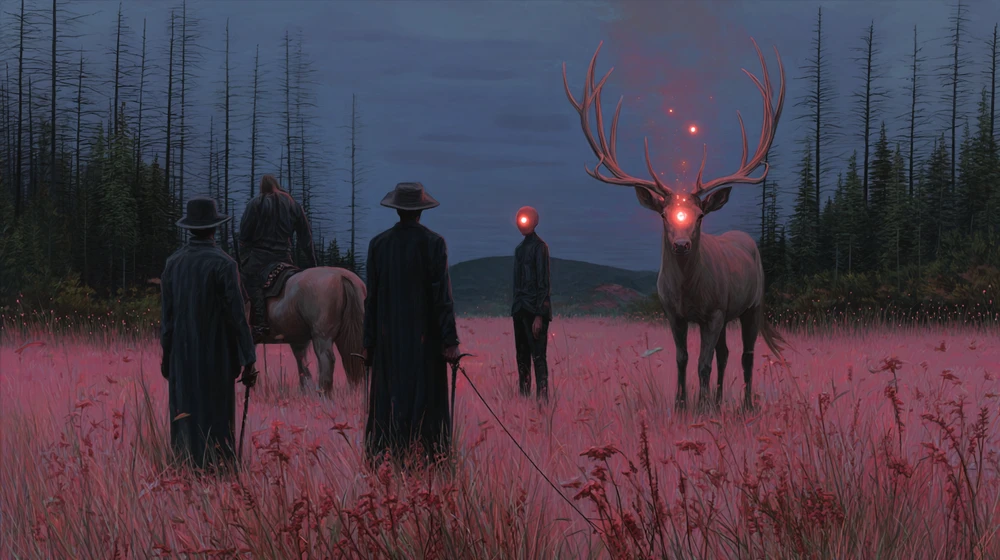
Animated hooded skeletal rider with a blue lantern riding across a frozen black lake at dusk, a tower on a cliff behind
Erster Frame: Animated hooded skeletal rider with a blue lantern riding across a frozen black lake at dusk, a tower on a cliff behind
Erster Frame
00:05

Ein Reiter auf einem gefrorenen See

Eine entsättigte Farbpalette mit einer einzelnen Farbglut in einem fernen Fenster hält das Auge in einer nahezu monochromen Szene in Bewegung.
The skeletal horse walks slowly across the frozen black lake, its hooves scattering thin frost, the rider's ragged cloak trailing in the wind and the blue lantern swinging and flickering on the staff. Mist drifts low over the ice and the ember window in the far tower glows. Slow lateral tracking shot, the painterly dark fantasy look kept in every frame, no text.
Bedeutung:Ein Skelettross schreitet über den gefrorenen schwarzen See, der Reiter trägt einen zerfetzten Umhang, die blaue Laterne schwingt im langsamen Tracking-Shot im düsteren Fantasy-Malstil.
Schiefes Holzdorf in der Nacht mit einer dornigen Ranke, die den Kirchturm umschlingt, und einer verhüllten Gestalt mit einer Laterne

Ein verfluchtes Dorf in der Nacht

Radiergungsartige Schraffur mit gemalter Farbe bewegt Dark Fantasy in Richtung düsterer Märchenillustration.
Dark fairy tale illustration with etching-like line texture and painted colour. An abandoned village of crooked timber houses at night, every window dark except one; a giant thorned vine has grown over the church tower and wrapped its bell, and a hooded figure with a lantern stands on the muddy road looking up at it. Sickly yellow lantern glow against deep green and black, ravens on the rooftops, fine hatching in the shadows. Eerie and storybook-like. No text, no signature.
Bedeutung:Ein verlassenes Dorf bei Nacht mit Dornenranken am Kirchturm und einer Gestalt mit Laterne in maerchenhafter Illustration mit Radierungstextur.

Was macht einen Dark-Fantasy-Prompt wirksam?

Benenne das Licht, den Verfall und die Dimensionen, denn diese entscheiden mehr als das Wort „dunkel", ob das Modell Grauen oder nur ein trübes Bild malt.
  • Licht: eine Quelle in einem dunklen Rahmen, wie ein grünes Fenster, Kerzen, eine Laterne oder ein blasser Mond, mit heavy chiaroscuro.
  • Verfall: Ruinen, tote Bäume, Fäulnis, Rost, zerrissener Stoff und Knochen, damit die Welt eindeutig etwas verloren hat.
  • Dimensionen: eine kleine Figur vor gigantischen Wurzeln, Türmen oder Kreaturen lässt die Welt größer als den Helden wirken.
  • Schließe aus, was den Look bricht: no text, no signature, und vermeide Wörter wie hell oder episch, die das Modell in Richtung heroischer Fantasy drängen.

Was ist der Unterschied zwischen Dark Fantasy und Horror?

Dark Fantasy ist eine erfundene Welt voller Magie, Monster und Königreiche, die in düsterer Stimmung erzählt wird, während Horror darauf abzielt, in einer Welt zu erschrecken, die unserer eigenen nahekommt.
  • Beschreibe für Dark Fantasy die Welt: ihre Burgen, Rüstungen, Bestien und Flüche.
  • Für eine erschreckende Geschichte in einem Haus, einer Stadt oder einem Wald in der Gegenwart verwende den AI-Horror-Videogenerator.
  • Für eine einzelne große Bestie als Hauptmotiv siehe den AI-Drachengenerator.

Häufig gestellte Fragen zum AI Dark Fantasy Art Generator

Wie erstelle ich Dark Fantasy Art mit AI?

Beschreibe eine einzelne Figur in einer verfallenden Fantasy-Umgebung mit einer einzigen Lichtquelle, etwa einen Ritter vor einer Kathedrale, die grün im Nebel leuchtet, wähle einen Dark-Fantasy-Stil und generiere. In Flick kannst du das Standbild anschließend zu einem Clip animieren.

Welche Farben werden in Dark Fantasy Art verwendet?

Dark Fantasy Art setzt auf Anthrazit, Schwarz, Knochenweiß, Kaltblau und Grau, mit Akzenten aus getrocknetem Blutrot, Glutorange oder einem krankhaften Grün von einer einzelnen Lichtquelle.

Kann ich ein Dark-Fantasy-Video erstellen, nicht nur ein Bild?

Ja. Generiere zuerst das Standbild und verwende es dann als Startframe eines Bild-zu-Video-Modells in Flick. Beschreibe eine langsame Bewegung, die zur Stimmung passt, etwa treibender Nebel, kreisende Raben oder ein sich im Wind bewegender Umhang.

Wie behalte ich dasselbe Monster oder denselben Ritter über mehrere Szenen hinweg bei?

Generiere zuerst ein Charakterblatt mit Vorder-, Seiten- und Rückansicht und gib dieses Blatt dann als Referenz für jedes spätere Bild oder Video an, wodurch das Design von Einstellung zu Einstellung gleich bleibt.

Ist der Dark-Fantasy-Art-Generator kostenlos?

Ja, der Einstieg ist kostenlos: Der Free-Tarif gibt jede Woche 100 Credits ohne Kreditkarte, und GPT Image 2.6 läuft damit. Videomodelle wie Seedance 2.5 benötigen den Standard-Tarif (20 $ pro Monat).

Weitere Dark-Fantasy-Stile in Flick

Probiere den Dark-Fantasy-Stil in Flick

Kostenlos testen, keine Kreditkarte erforderlich.

KI zu dieser Seite fragen:ChatGPTPerplexityClaude