Como Usar Kling AI para Fazer um Curta-Metragem em 7 Passos
Para usar Kling AI em um curta-metragem, forneça um quadro inicial finalizado, depois escreva cada cena como um movimento de câmera, uma ação e uma fala, com uma lista do que evitar.
A maioria dos primeiros vídeos do Kling perde consistência: rostos mudam entre cenas, a câmera vaga e a voz é diferente toda vez. Karan Archana fez Drop of Water, um drama de 3:21 sobre seca para a Residência de Verão 2026 do Flick, com 89 clipes Kling 3.0 4K em um único canvas do Flick. Lemos cada um daqueles prompts e suas configurações. Este guia mostra como usar Kling AI da forma que Karan usou, em sete etapas, cada uma com uma cena real do filme e o prompt exato que a criou.
Modelos de vídeo Kling no Flick funcionam no plano Standard e superiores.
Como você usa Kling AI para fazer um curta-metragem, passo a passo?
Em sete etapas, de uma ficha de personagem a uma tomada final fixa, tudo do fluxo de trabalho de Drop of Water.
Passo 1
Crie uma ficha de personagem
Faça uma ficha de rotação para cada personagem antes de qualquer vídeo, para que cada quadro inicial do Kling seja criado a partir do mesmo rosto e roupas.
Seis painéis de Ken em fundo branco: frente, ambos os perfis, costas e dois close-ups do rosto.
Feito com GPT Image 2, a partir de três retratos anteriores dele.
Karan fez a mesma ficha para Evelyn, além de uma ficha de expressões para cada um.
Drop of Water, dirigido por Karan Archana · GPT Image 2
Professional character turnaround reference sheet for Ken: a late 30s South Asian man, medium brown skin, lean athletic build around 5'10", short slightly wavy black hair, sharp tired intelligent eyes, strong jaw, wearing dark slim-fit cargo trousers, a fitted grey technical shirt, lightweight jacket, heavy duty boots. Create ONE wide image showing SIX panels: full body front view, full body left profile, full body right profile, full body back view, AND one close-up of face from the right side, AND one close-up of face from the left side. Same character in every panel, 100% identical face and clothing matching the reference exactly, neutral A-pose for full body panels, plain pure white seamless background, even flat lighting, orthographic framing. No scene, no props, no other people.
Significado:Ficha de referência profissional mostra Ken, homem sul-asiático de trinta e tantos anos, em seis painéis com poses e closes.
A conversão de imagem para vídeo do Kling começa da sua imagem, então Karan definiu cada quadro primeiro, reenquadrando um still de uma cena anterior com ambas as fichas de Ken anexadas.
A imagem 1 é a cena, as imagens 2 e 3 são as folhas de referência.
Uma mudança: um close apertado apenas do Ken, sem a Evelyn.
Feito com Nano Banana Pro; cada um dos 89 clipes Kling começou de uma imagem como esta.
Drop of Water, dirigido por Karan Archana · Nano Banana Pro
Image 1 is the scene: a two-shot of the man Ken (left, glasses, brown vest over grey tee, curly hair, beard) drinking green liquid from a transparent sachet in a dim dusty room, with the woman Evelyn on the right. Images 2 and 3 are reference sheets of Ken — use them to keep his face 100 percent accurate: exact features, glasses, beard, hairstyle, skin texture. Re-frame this into a tight close up on Ken ALONE, filling the frame, in the exact same moment of raising the transparent sachet to his lips and drinking, eyes lowered. Evelyn is completely gone from the frame and must not be visible at all. Keep everything from image 1 identical: Ken's identity, his clothing, the sachet with green liquid, the dim dusty room, the warm muted color palette, window light, lighting mood and photorealistic texture and grain. Shallow depth of field, background soft. Grounded cinematic realism.
Significado:Close apertado em Ken sozinho bebendo líquido verde de sachê transparente em sala empoeirada, realismo cinematográfico fotorrealista com profundidade de campo rasa.
Passo 3
Nomeie um movimento de câmera
Descreva um movimento de câmera, onde começa, quão rápido vai e onde termina, para que Kling não invente pushes ou cortes próprios.
Um único pan, da esquerda para a direita, ao longo da cerca.
A velocidade é especificada: cerca de um terço de um pan normal.
A placa entra, pausa por um momento e sai.
A duração é definida ao lado do prompt: 3, 5, 10 ou 15 segundos no Kling 3.0 4K.
Primeiro quadro00:10
Drop of Water, dirigido por Karan Archana · Kling 3.0 4K · Imagem para vídeo
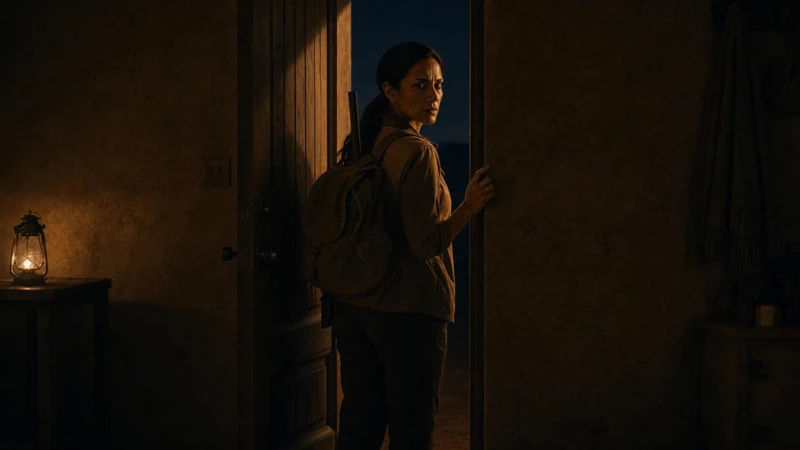
The camera begins at the far left end of the barbed wire fence, framing only the rusted wire strands stretching across the blood-orange desert horizon. A very slow, almost glacial pan moves right along the fence line — the wire fills the frame, repeating rhythmically, the cracked earth below and the smoky red sky above. The pan speed is extremely slow — the camera should move only about one third of the distance it would in a normal pan over the full 5 seconds. The fence seems endless. Then, gradually, the weathered wooden post and the rusted "ENTRY TO NORTHLAND IS PROHIBITED" sign drift into frame. The camera barely lingers on the sign for a beat — just long enough to register its presence — then continues its imperceptibly slow pan to the right. The sign drifts out of frame. Only fence wire remains. The world is silent, red, and still. No rush. No acceleration. The entire shot breathes slowly.
Significado:Uma panorâmica muito lenta segue uma cerca de arame farpado no deserto laranja-sangue até uma placa enferrujada de proibição aparecer e sumir.
Passo 4
Liste o que evitar
Divida o prompt em cena, uma lista curta dos movimentos permitidos e uma lista EVITAR, para que Kling mantenha uma performance discreta discreta.
A lista de animação tem cinco linhas, um movimento cada.
A lista EVITAR proíbe escolhas de atuação assim como movimentos de câmera.
59 dos 89 prompts Kling no filme terminam com uma lista como esta.
Primeiro quadro00:05
Drop of Water, dirigido por Karan Archana · Kling 3.0 4K · Imagem para vídeo
Prompt

Continue inside the same weathered house immediately after Ken lowers the government-issued water ration pouch. Maintain identical lighting, wardrobe, production design, and atmosphere. Ken stands near the back sliding door, his body still facing the window. After a long moment of silence, he slowly turns his head just enough to acknowledge Evelyn without fully facing her. His expression is calm, compassionate, and tired. He speaks quietly and gently, without anger or urgency. Evelyn stands a few feet behind him, listening in silence. She remains almost perfectly still. The camera is locked in a medium shot with an almost imperceptible slow push forward. Natural breathing, subtle eye movement, restrained body language. Photorealistic live-action film, grounded realism, naturalistic cinematography, practical production design, documentary authenticity.

Animation
Ken slowly turns his head.
Speaks quietly.
Evelyn listens without moving.
Dust drifts in the light.
No other movement.

AVOID :

Dramatic acting, exaggerated emotion, crying, shouting, large gestures, camera shake, handheld movement, camera pan, zoom, cinematic swoops, cartoon style, text, logos, AI artifacts.
Significado:Ken vira a cabeça devagar e fala baixo enquanto Evelyn escuta imóvel na casa iluminada naturalmente com estética realista documental.
Passo 5
Escreva a fala entre aspas
Coloque as palavras exatas entre aspas e descreva como elas são ditas, porque o Kling 3.0 4K gera a voz junto com a imagem.
Uma fala, cinco palavras, com a respiração e o balanço de cabeça antes dela.
A entrega é descrita: calma, baixa, objetiva.
Um silêncio mantido após a fala, escrito no prompt.
O som vem da configuração Gerar Áudio, ativada por padrão.
Primeiro quadro00:05
Drop of Water, dirigido por Karan Archana · Kling 3.0 4K · Imagem para vídeo
Use the attached image as the exact first frame. Preserve the exact composition, characters, clothing, lighting, colour palette, room, lens, camera position and cinematic realism. Continue directly from the previous shot.

Preserve Evelyn's existing voice exactly as established in the previous dialogue scenes. Use the same voice, accent, tone, cadence, pitch, emotional restraint and vocal characteristics already heard in the film. Do not generate a new voice or alter her vocal performance in any way. This line should sound like it is spoken by the same Evelyn from the preceding scene.

Evelyn maintains eye contact with Ken in silence. Her expression is weary, composed and quietly devastated. She takes one small breath, gives the slightest shake of her head and softly says:

"They're not coming back."

Her delivery is calm, low and matter-of-fact. She is not trying to convince Ken—she has already accepted what he cannot. After speaking, she remains still, holding his gaze for two seconds without speaking.

Ken remains softly out of focus in the foreground and barely moves. The camera stays completely locked off. Natural lip synchronization, subtle breathing, one slow blink, grounded cinematic realism.

Avoid

Do not change Evelyn's voice. Do not synthesize a different accent, pitch, cadence or emotional style. Do not make her sound younger, older, robotic or theatrical. Do not alter her face, hairstyle, clothing, posture or eyeline. Do not change Ken, the room, lighting, framing or colour grade. No camera movement, zoom, push-in, rack focus or reframing. No crying, shouting, trembling lips, exaggerated facial expressions or dramatic gestures. Do not add dialogue before or after the exact line. Keep Ken softly out of focus and Evelyn in sharp focus throughout.
Significado:Evelyn olha Ken com expressão cansada e devastada e diz calmamente que eles não voltarão em cena cinematográfica realista e estática.
Passo 6
Corte para a resposta
Filme uma conversa como um clipe Kling por fala, cada um começando de um novo quadro por cima do ombro e pedindo pela voz já ouvida.
O ângulo reverso do último passo, feito a partir de um quadro estático de uma tomada anterior.
O prompt repete a instrução de voz e a câmera travada.
A própria nota de Karan sobre a redação ainda está no prompt, citada como escrita.
Primeiro quadro00:05
Drop of Water, dirigido por Karan Archana · Kling 3.0 4K · Imagem para vídeo
Use the attached image as the exact first frame. Preserve the exact composition, camera angle, lens, lighting, colour palette, production design, costumes and photorealistic cinematic style. Continue directly from the previous dialogue shot.

Preserve Ken's existing voice exactly as established in the previous dialogue scenes. Use the same voice, accent, cadence, pitch, emotional restraint and vocal characteristics already heard in the film. Do not generate a new voice or alter his vocal performance in any way. This line must sound as though it is part of the same continuous conversation.

Ken maintains eye contact with Evelyn, who remains softly out of focus in the foreground. He hesitates for a moment, searching her face before quietly asking:

"What if they come home... and no one is here?"

His voice is gentle, tired and quietly hopeful. He is not arguing with Evelyn. He is holding on to the last possibility that their daughters might still return. The line is spoken softly, with a small pause after "come home..." as he struggles to finish the thought.

After speaking, Ken continues looking at Evelyn in silence. He takes one subtle breath, blinks once naturally and remains completely still. Hold the silence for one to two seconds after the line finishes.

The camera remains perfectly locked off. Natural lip synchronization. Subtle breathing. Grounded cinematic realism.

Performance Notes
Quiet, restrained delivery.
No anger.
No pleading.
No melodrama.
His hope is fragile rather than desperate.
Let the silence after the line carry as much emotion as the dialogue itself.
Avoid

Do not change Ken's voice, accent, pitch or cadence. Do not alter Ken's face, hair, glasses, clothing, posture or eyeline. Do not change Evelyn's silhouette, the room, fireplace, lighting, framing or warm amber colour grading. No camera movement, zoom, push-in, pan or rack focus. No tears, shouting, dramatic gestures, exaggerated facial expressions or theatrical acting. Do not add dialogue before or after the exact line. Preserve the intimate, quiet realism of the surrounding scene.

I also think the wording "come home" is stronger than "come back." Earlier, Evelyn says, "They're not coming back." Then Ken asks, "What if they come home... and no one is here?" The repetition of the same idea from opposite emotional perspectives gives the exchange a quiet symmetry without feeling repetitive.
Significado:Ken olha para Evelyn em foco suave e pergunta com voz cansada se as filhas voltarem para casa, estilo cinematográfico realista e intimista.
Passo 7
Corrija uma tomada, mantenha o resto
Quando um objeto sai errado em uma boa tomada, edite o clipe com Kling O3 Pro em vez de gerá-lo novamente, e liste tudo que deve permanecer.
O sachê na mão do Ken tinha mudado entre as tomadas, então a edição substitui o sachê e nada mais.
O prompt lista o que preservar, desde o enquadramento até o timing dos diálogos.
A edição mantém o som original da tomada e é cobrada por segundo do clipe fonte.
00:10
Drop of Water, dirigido por Karan Archana · Kling O3 Pro
Edit only the empty water sachet in Ken's left hand. Do not change anything else.

This is a continuity correction.

Replace the current sachet with the same almost-empty transparent plastic water sachet containing only a small amount of bright green liquid exactly as it appears in the previous shot (reference image attached).

The sachet must:

remain in Ken's left hand throughout the entire shot
have the same size, shape, folds, transparency, remaining liquid level and orientation as the previous shot
move naturally with his hand as he turns toward Evelyn
never disappear, refill, change color or change shape

Do not alter anything else.

Preserve exactly:

camera framing
composition
lens
lighting
warm amber color palette
Ken and Evelyn's faces
body positions
clothing
dialogue timing
background
room
facial expressions
pacing

The only change should be replacing the incorrect sachet with the matching continuity sachet from the previous shot.

This is a precision continuity edit, not a regeneration. Maintain cinematic realism in the style of Denis Villeneuve and Children of Men.

One additional suggestion: attach two reference images if Flick allows it.

The last frame of the previous shot, where the sachet is correct.
The first frame of the current shot, where everything is correct except the sachet.

That gives Flick a very explicit "copy from A, paste into B" task, which generally produces more reliable continuity edits than relying on a text description alone.
Significado:Correção de continuidade que substitui o saquinho de água na mão de Ken pelo mesmo saquinho transparente com líquido verde da cena anterior.
Quais configurações do Kling foram usadas em um curta-metragem real?
Clipes curtos com som ativado: 57 dos 89 clipes Kling 3.0 4K em Drop of Water têm 5 segundos, e todos os 89 geram áudio.
Os 89 clipes Kling 3.0 4K no canvas público de Drop of Water, consultados em 26/10/2026. Um prompt pode contar em mais de uma linha.
O que o clipe solicita
Clipes
5 segundos de duração
57
10 segundos de duração
28
15 segundos de duração
4
Áudio gerado
89
Uma lista de exclusões no prompt
59
Uma câmera travada ou parada
51
Continua da tomada anterior
50
Uma fala entre aspas
29
Um quadro final assim como um quadro inicial
1
Mais detalhes: como contamos
Lemos as configurações e o prompt de cada clipe Kling 3.0 4K salvo no canvas público do filme. Uploads e takes deletados não são contados.
Lista de evitar: a palavra "avoid" no prompt.
Câmera travada: "locked", "no camera movement" ou "the camera remains completely still".
Continua: "previous shot", "last frame", "final frame" ou "continue".
Linha falada: um par de aspas duplas no prompt.
O prompt mediano tem 176 palavras.
Perguntas sobre o uso de Kling AI
O que é Kling AI?
Kling é uma família de modelos de vídeo AI da Kuaishou que transformam uma imagem inicial e um prompt de texto em um clipe de vídeo, muitos deles com som. No Flick, Kling funciona no mesmo canvas que os modelos de imagem, então uma folha de personagem, um quadro inicial e o clipe ficam lado a lado.
Quais modelos Kling posso usar no Flick?
Para imagem para vídeo: Kling 3.0 4K, Kling 3.0 Pro, Kling 3.0, Kling O3 Pro, Kling O3 e Kling 2.6 Pro. O mais recente, Kling 4.0, chegou ao Flick em 26 de outubro de 2026, depois que Drop of Water foi feito, então os clipes neste guia são Kling 3.0 4K. Flick também tem Kling O3 Pro Multishot para clipes multi-shot a partir de imagens de referência, Kling AI Avatar v2 para avatares falantes, edição de vídeo Kling O3 Pro e Kling Image V3 para imagens.
Kling AI é gratuito para usar?
Vídeo Kling no Flick precisa do plano Standard ou superior, a partir de $20 por mês. Kling Image V3 está no plano Free, e o Flick dá 100 créditos quando você se cadastra.
Quantos créditos custa um vídeo Kling no Flick?
Um clipe Kling 3.0 4K custa 330 créditos em seu comprimento padrão e 990 créditos em seu comprimento máximo. Uma edição Kling O3 Pro é cobrada por segundo do clipe que você edita.
Qual o tamanho de um vídeo Kling?
Um clipe Kling 3.0 4K no Flick dura 3, 5, 10 ou 15 segundos. Para uma cena mais longa, inicie o próximo clipe a partir do último quadro do anterior, da mesma forma que Drop of Water encadeia suas tomadas.
O Kling AI pode fazer diálogos com som?
Sim. O Kling 3.0 4K gera áudio junto com a imagem, com a configuração Gerar Áudio ativada por padrão. Escreva a linha exata entre aspas, quem a diz e como, e descreva o silêncio antes e depois dela.
Como mantenho o mesmo personagem em cada tomada Kling?
Faça uma ficha de personagem primeiro, depois construa cada quadro inicial a partir dela com um modelo de imagem, e anime no Kling por último. O quadro inicial carrega o rosto, então o modelo de vídeo nunca precisa adivinhar.
O Kling pode usar um quadro inicial e um final?
O Kling 3.0 4K aceita um quadro final opcional: Sim. Forneça a primeira e a última imagem de uma tomada, e o Kling cria o movimento entre elas.
Mais sobre Kling e produção de filmes com IA no Flick
Cada tomada nesta página vem do canvas público Drop of Water e é creditada ao seu cineasta, Karan Archana. Os prompts são citados exatamente como escritos no canvas.
Faça seu primeiro curta-metragem Kling no Flick
Fichas de personagens, quadros iniciais e todos os modelos de vídeo Kling em um canvas, da mesma forma que Drop of Water foi feito.



 00:10