Professional character turnaround reference sheet for Ken: a late 30s South Asian man, medium brown skin, lean athletic build around 5'10", short slightly wavy black hair, sharp tired intelligent eyes, strong jaw, wearing dark slim-fit cargo trousers, a fitted grey technical shirt, lightweight jacket, heavy duty boots. Create ONE wide image showing SIX panels: full body front view, full body left profile, full body right profile, full body back view, AND one close-up of face from the right side, AND one close-up of face from the left side. Same character in every panel, 100% identical face and clothing matching the reference exactly, neutral A-pose for full body panels, plain pure white seamless background, even flat lighting, orthographic framing. No scene, no props, no other people.
Image 1 is the scene: a two-shot of the man Ken (left, glasses, brown vest over grey tee, curly hair, beard) drinking green liquid from a transparent sachet in a dim dusty room, with the woman Evelyn on the right. Images 2 and 3 are reference sheets of Ken — use them to keep his face 100 percent accurate: exact features, glasses, beard, hairstyle, skin texture. Re-frame this into a tight close up on Ken ALONE, filling the frame, in the exact same moment of raising the transparent sachet to his lips and drinking, eyes lowered. Evelyn is completely gone from the frame and must not be visible at all. Keep everything from image 1 identical: Ken's identity, his clothing, the sachet with green liquid, the dim dusty room, the warm muted color palette, window light, lighting mood and photorealistic texture and grain. Shallow depth of field, background soft. Grounded cinematic realism.
Karan Archana監督『Drop of Water』 · Kling 3.0 4K · 画像から動画へ
The camera begins at the far left end of the barbed wire fence, framing only the rusted wire strands stretching across the blood-orange desert horizon. A very slow, almost glacial pan moves right along the fence line — the wire fills the frame, repeating rhythmically, the cracked earth below and the smoky red sky above. The pan speed is extremely slow — the camera should move only about one third of the distance it would in a normal pan over the full 5 seconds. The fence seems endless. Then, gradually, the weathered wooden post and the rusted "ENTRY TO NORTHLAND IS PROHIBITED" sign drift into frame. The camera barely lingers on the sign for a beat — just long enough to register its presence — then continues its imperceptibly slow pan to the right. The sign drifts out of frame. Only fence wire remains. The world is silent, red, and still. No rush. No acceleration. The entire shot breathes slowly.
Karan Archana監督『Drop of Water』 · Kling 3.0 4K · 画像から動画へ
Prompt

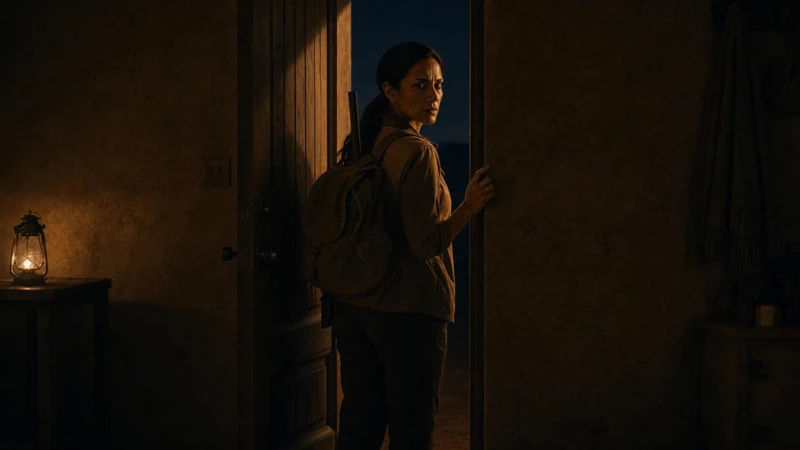
Continue inside the same weathered house immediately after Ken lowers the government-issued water ration pouch. Maintain identical lighting, wardrobe, production design, and atmosphere. Ken stands near the back sliding door, his body still facing the window. After a long moment of silence, he slowly turns his head just enough to acknowledge Evelyn without fully facing her. His expression is calm, compassionate, and tired. He speaks quietly and gently, without anger or urgency. Evelyn stands a few feet behind him, listening in silence. She remains almost perfectly still. The camera is locked in a medium shot with an almost imperceptible slow push forward. Natural breathing, subtle eye movement, restrained body language. Photorealistic live-action film, grounded realism, naturalistic cinematography, practical production design, documentary authenticity.

Animation
Ken slowly turns his head.
Speaks quietly.
Evelyn listens without moving.
Dust drifts in the light.
No other movement.

AVOID :

Dramatic acting, exaggerated emotion, crying, shouting, large gestures, camera shake, handheld movement, camera pan, zoom, cinematic swoops, cartoon style, text, logos, AI artifacts.
Karan Archana監督『Drop of Water』 · Kling 3.0 4K · 画像から動画へ
Use the attached image as the exact first frame. Preserve the exact composition, characters, clothing, lighting, colour palette, room, lens, camera position and cinematic realism. Continue directly from the previous shot.

Preserve Evelyn's existing voice exactly as established in the previous dialogue scenes. Use the same voice, accent, tone, cadence, pitch, emotional restraint and vocal characteristics already heard in the film. Do not generate a new voice or alter her vocal performance in any way. This line should sound like it is spoken by the same Evelyn from the preceding scene.

Evelyn maintains eye contact with Ken in silence. Her expression is weary, composed and quietly devastated. She takes one small breath, gives the slightest shake of her head and softly says:

"They're not coming back."

Her delivery is calm, low and matter-of-fact. She is not trying to convince Ken—she has already accepted what he cannot. After speaking, she remains still, holding his gaze for two seconds without speaking.

Ken remains softly out of focus in the foreground and barely moves. The camera stays completely locked off. Natural lip synchronization, subtle breathing, one slow blink, grounded cinematic realism.

Avoid

Do not change Evelyn's voice. Do not synthesize a different accent, pitch, cadence or emotional style. Do not make her sound younger, older, robotic or theatrical. Do not alter her face, hairstyle, clothing, posture or eyeline. Do not change Ken, the room, lighting, framing or colour grade. No camera movement, zoom, push-in, rack focus or reframing. No crying, shouting, trembling lips, exaggerated facial expressions or dramatic gestures. Do not add dialogue before or after the exact line. Keep Ken softly out of focus and Evelyn in sharp focus throughout.
Karan Archana監督『Drop of Water』 · Kling 3.0 4K · 画像から動画へ
Use the attached image as the exact first frame. Preserve the exact composition, camera angle, lens, lighting, colour palette, production design, costumes and photorealistic cinematic style. Continue directly from the previous dialogue shot.

Preserve Ken's existing voice exactly as established in the previous dialogue scenes. Use the same voice, accent, cadence, pitch, emotional restraint and vocal characteristics already heard in the film. Do not generate a new voice or alter his vocal performance in any way. This line must sound as though it is part of the same continuous conversation.

Ken maintains eye contact with Evelyn, who remains softly out of focus in the foreground. He hesitates for a moment, searching her face before quietly asking:

"What if they come home... and no one is here?"

His voice is gentle, tired and quietly hopeful. He is not arguing with Evelyn. He is holding on to the last possibility that their daughters might still return. The line is spoken softly, with a small pause after "come home..." as he struggles to finish the thought.

After speaking, Ken continues looking at Evelyn in silence. He takes one subtle breath, blinks once naturally and remains completely still. Hold the silence for one to two seconds after the line finishes.

The camera remains perfectly locked off. Natural lip synchronization. Subtle breathing. Grounded cinematic realism.

Performance Notes
Quiet, restrained delivery.
No anger.
No pleading.
No melodrama.
His hope is fragile rather than desperate.
Let the silence after the line carry as much emotion as the dialogue itself.
Avoid

Do not change Ken's voice, accent, pitch or cadence. Do not alter Ken's face, hair, glasses, clothing, posture or eyeline. Do not change Evelyn's silhouette, the room, fireplace, lighting, framing or warm amber colour grading. No camera movement, zoom, push-in, pan or rack focus. No tears, shouting, dramatic gestures, exaggerated facial expressions or theatrical acting. Do not add dialogue before or after the exact line. Preserve the intimate, quiet realism of the surrounding scene.

I also think the wording "come home" is stronger than "come back." Earlier, Evelyn says, "They're not coming back." Then Ken asks, "What if they come home... and no one is here?" The repetition of the same idea from opposite emotional perspectives gives the exchange a quiet symmetry without feeling repetitive.
Edit only the empty water sachet in Ken's left hand. Do not change anything else.

This is a continuity correction.

Replace the current sachet with the same almost-empty transparent plastic water sachet containing only a small amount of bright green liquid exactly as it appears in the previous shot (reference image attached).

The sachet must:

remain in Ken's left hand throughout the entire shot
have the same size, shape, folds, transparency, remaining liquid level and orientation as the previous shot
move naturally with his hand as he turns toward Evelyn
never disappear, refill, change color or change shape

Do not alter anything else.

Preserve exactly:

camera framing
composition
lens
lighting
warm amber color palette
Ken and Evelyn's faces
body positions
clothing
dialogue timing
background
room
facial expressions
pacing

The only change should be replacing the incorrect sachet with the matching continuity sachet from the previous shot.

This is a precision continuity edit, not a regeneration. Maintain cinematic realism in the style of Denis Villeneuve and Children of Men.

One additional suggestion: attach two reference images if Flick allows it.

The last frame of the previous shot, where the sachet is correct.
The first frame of the current shot, where everything is correct except the sachet.

That gives Flick a very explicit "copy from A, paste into B" task, which generally produces more reliable continuity edits than relying on a text description alone.



 00:10