Behind the film
- 59 video generations
- 59 image generations
- 8 models
- 532 s of video generated
How it was made
-
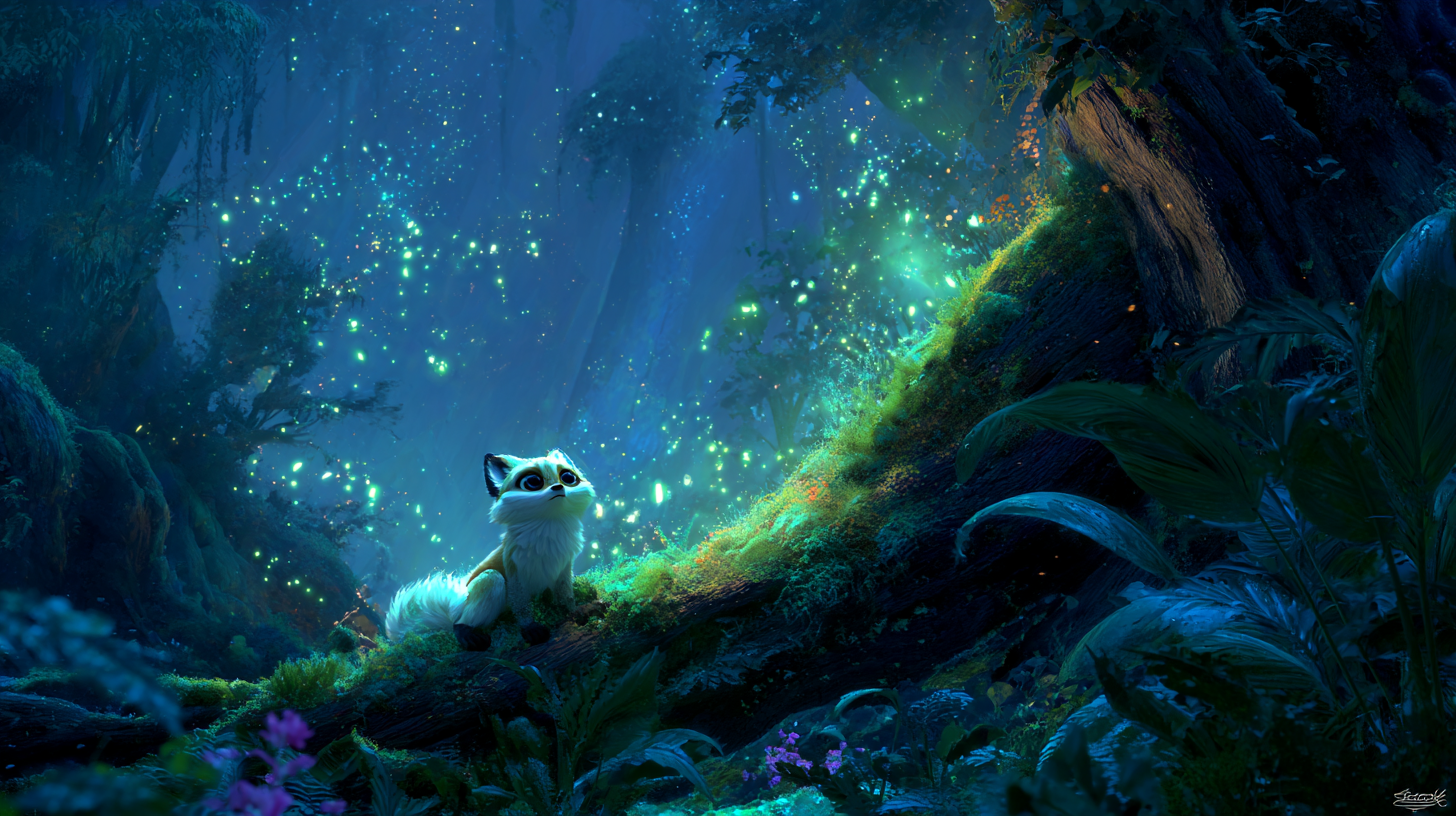
Start from one written idea
The idea was written in a note on the canvas as one long take, and the same text went into Midjourney. A single variation of that forest became the most used image in the workflow, a reference in 13 generations.
A single continuous, uninterrupted long take through a moonlit ancient forest at night.
-
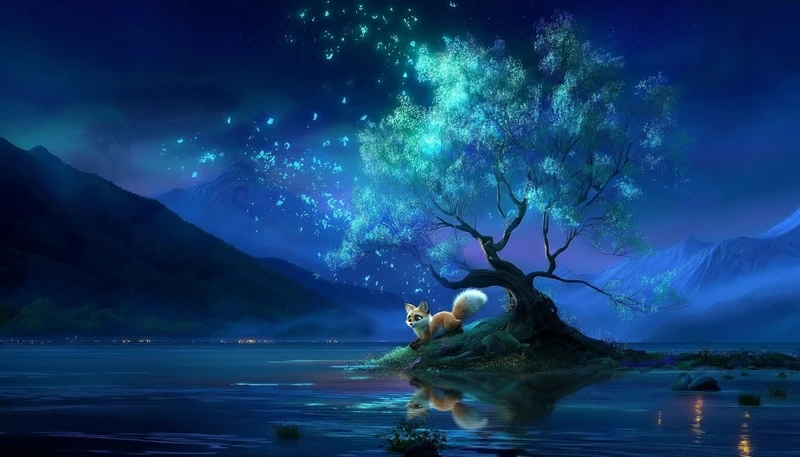
Direct with one-line edits
Shots were adjusted with 50 Nano Banana edits, most of them one line asking for a single change in plain words: a smaller fox, no pond, a view from high above.
let's make the fox way way smaller
-
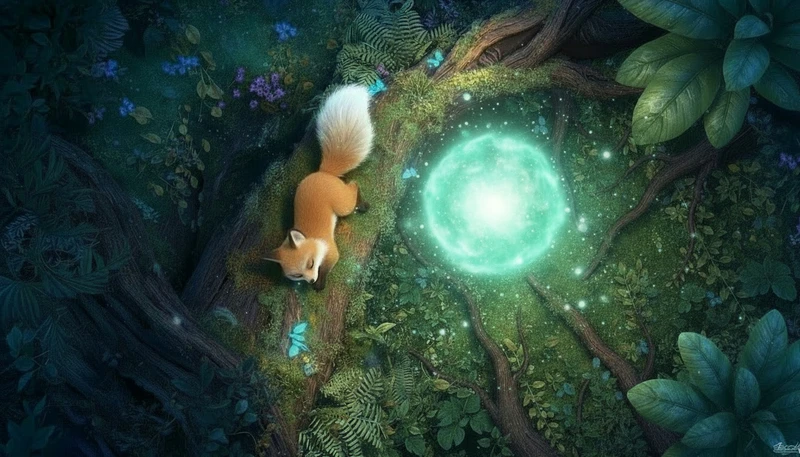
Tune the glow
The fox's light was designed through edits too: particles attached to its fur, hovering lights made smaller, then a color chosen for them.
make the glowing particles into glows with a soft greenish-blue hue, like bioluminescent energy
-
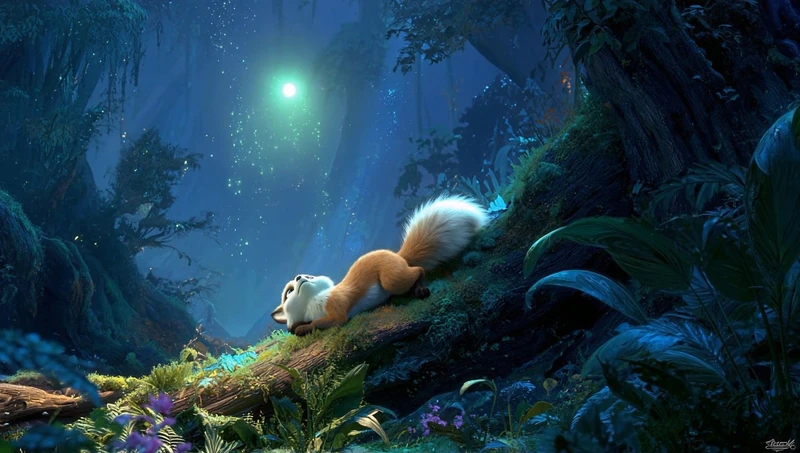
Continue shots from their last frame
So each shot picks up where another ended, 20 frames were pulled from finished clips and 10 clips start from one of them.
Use the input image as frame-0.
-
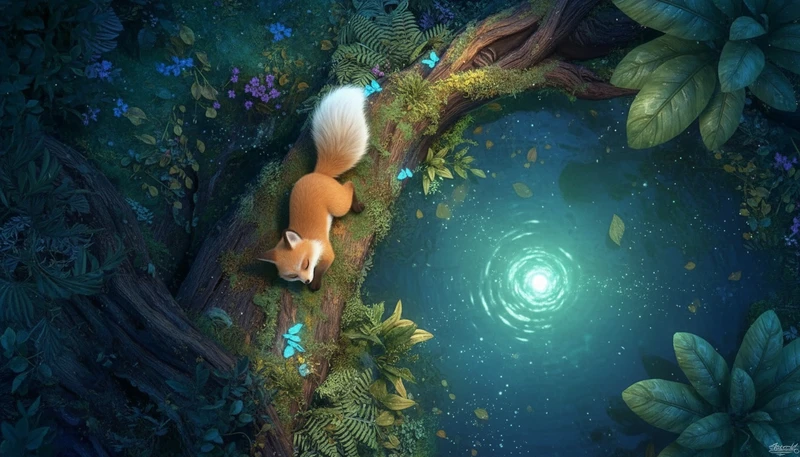
Give each clip one small action
The clips were made with Seedance Pro (36) and Wan 2.5 (22). Most prompts describe one small piece of the fox's behavior, the way an animator would act it out. This one starts from the still of the fox on a tree root.
The little fox lies down and falls asleep, using its tail as a blanket.
Assets
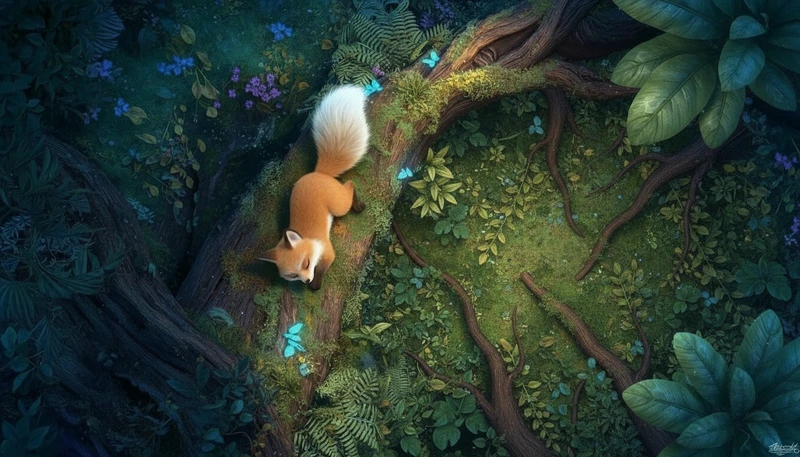 A fox is sitting on a tree branch: 3 shots use it
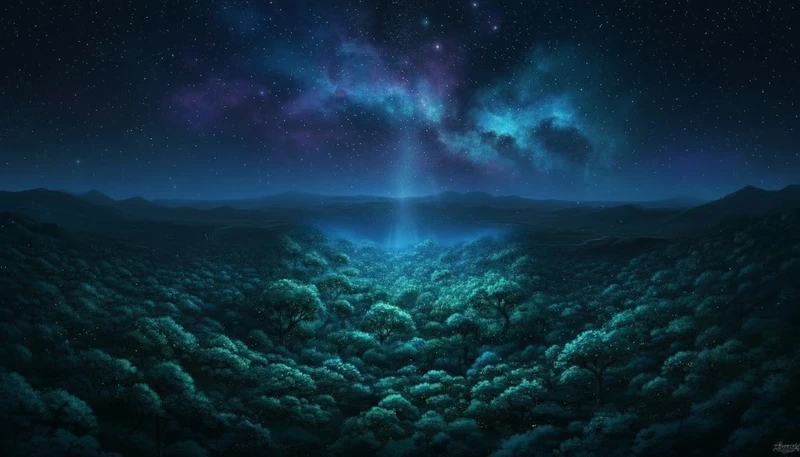 A bright light shines through the trees: 2 shots use it
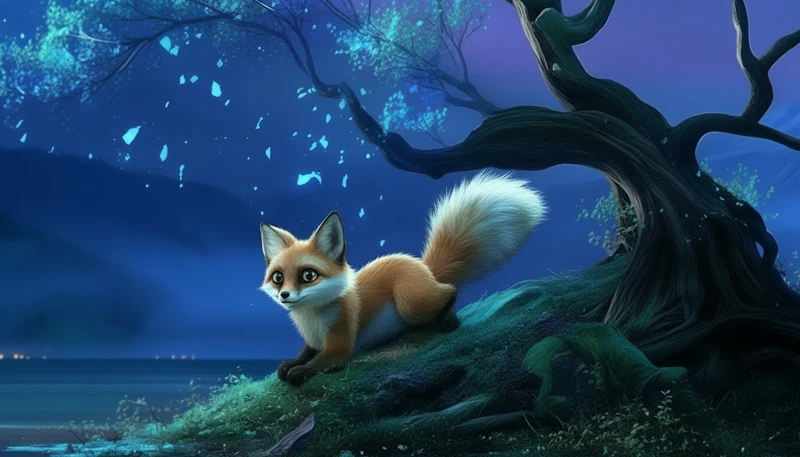 A fox sitting on a rock in front of a tree: 2 shots use it
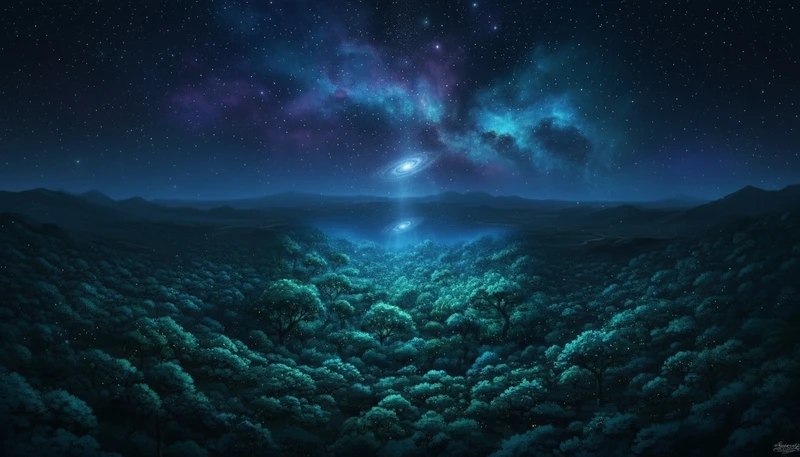 A starry night with a view of the galaxy: 2 shots use it
- A fox sits on a tree branch: 4 shots use it
- A fox sitting on a tree branch: 2 shots use it
Prompts
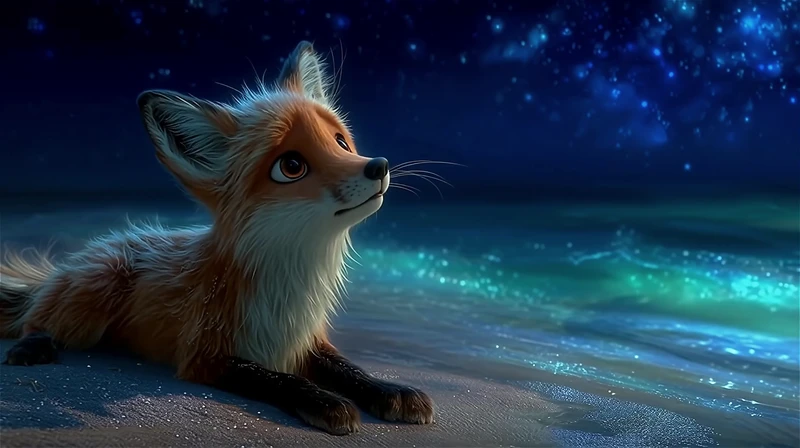
Locked-off tripod; medium-wide, low waterline angle (~35° side view), deep DoF, quiet minimalist mood. Using the reference image for look/character, animate only the action and FX: the fox exhales, gives two short sniffs, ears tilt ~5°, then slowly rises from a crouch (front elbows fold→extend), tail lifts/settles; it takes two tiny cautious steps to the shoreline, pauses half a beat, head tilts 8–10° studying the surface. The right forepaw lifts a couple centimeters above the water, toes splay, makes a small hesitation arc; paw barely touches the water—only fur tips get wet—and at the exact contact point new veil-light motes are born: tiny irregular dust-like glowing specks (0.5–2 mm), semi-transparent with feathered edges and a very gentle bloom (pale blue-teal with a subtle warm-white core). They seed along a soft expanding ripple ring (fast then easing). Split behavior into two groups, both visible: (A) near-fox motes hover just a few cm above the surface and move with a loose organic eddy/halo around the paw, forelegs, chest, and tail tip, with subtle life-like jitter (≈0.3–0.6 Hz); they never block the eyes or nose and paths are wobbly/hand-drawn, not graphic spirals. (B) wanderer motes peel off with the ripple/breeze, drifting outward and slightly upward into open water, density thinning with distance, then slowing to a calm hover. Reflections on water are softer and slightly warmer than the motes and never form shapes. The fox micro-flinches back 1–2 cm (“that’s cool”), then gently returns the paw for a second touch, creating a lighter secondary spawn on a subtler ripple; eyes briefly track one or two near-fox motes; ears rotate; tail slides to the side as a stabilizer. Spawn rate follows ripple amplitude and decays over time; once detached from the wavefront, motes keep low drift speed plus subtle random jitter (not ballistic). End on a calm hold with the lifted paw and both behaviors visible (soft near-fox eddy + sparse outward trail). Camera stays locked (allow tiny nodal rotation only, no dolly/zoom). Negatives: not insects or fog; no people/boats/buildings/city lights/strong moon/heavy flares; no concentric rings, no neon loops, no HUD/reticles, no glyphs/sigils, no perfect circles, no hard glowing outlines, no laser lines, no sparks or fireworks; no sudden motions or big splashes.
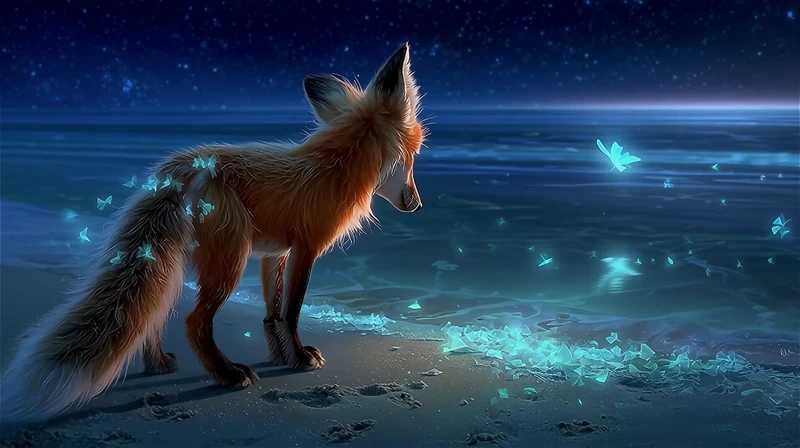
Use the input image as frame-0. Lock the camera (no pan/tilt/zoom, same lens, horizon, lighting, color and composition). Keep the same juvenile red-fox design, proportions, fur colors, ear size, and tail fluff as in the image; same beach + mirror-calm lake + starry sky. Do not change style or add new props. Action beats (≈10 s total): 0–2 s: The fox hesitates, ears forward, tail softly balancing. Tiny existing motes (from the image) continue to drift. 2–4 s: The fox takes 2–3 small steps backward on the wet sand (toward camera/left), leaving soft pawprints; body rocks back, preparing to leap. 4–7 s: The fox sprints forward and leaps into the shallow water (toward the lake/right). Contact splash: low, soft arcs of water droplets (no big waves). With the splash, the “light-veil” appears: glowing featherlets + tiny luminous butterflies burst from the water around the forepaws and chest—paper-thin semi-transparent blue-teal and warm-gold featherlets (2–6 cm, frayed edges, gentle inner glow) plus tiny simplified butterflies (1.5–3 cm wingspan, no detailed patterns, de-emphasized antennae). Density is highest at impact, then thins as they drift outward over the water; a few orbit the tail/shoulder for a moment before peeling away. 7–10 s: The fox settles in the shallows (partially in water). Splash rings fade quickly; motes hover 3–20 cm above the surface, slowly eddying with faint reflections; brightness decays with distance. Keep the scene clean, quiet, dreamlike. Constraints: keep rear three-quarter, over-the-shoulder angle; no face/side close-ups; no camera shake; no neon rings, no perfect circles, no HUD/sigils, no fireworks/sparks; no realistic insect anatomy on the butterflies; color mix ≈ 70% blue-teal, 30% warm gold; water splashes are soft and small. Do not change the fox model or palette.
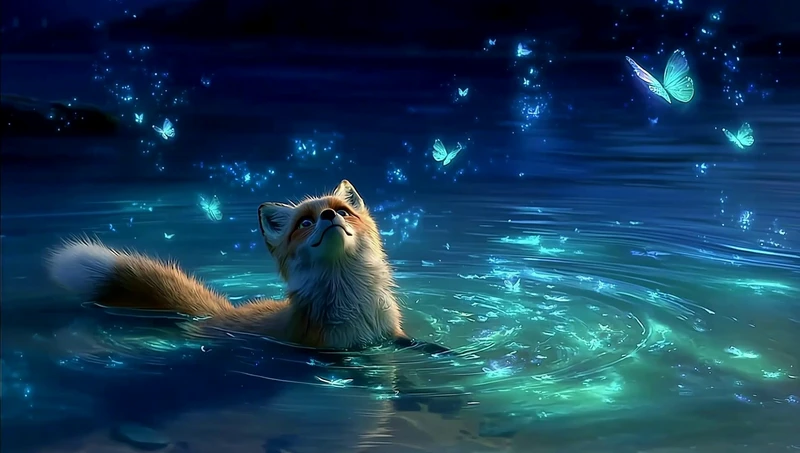
little fox tries to capture the glowing butterflies and creates a lot of splashes form at contact. From the splash area, two types of luminous particles burst out and drift: (1) glowing featherlets—paper-thin, semi-transparent blue-teal and warm-gold wisps, 2–6 cm long with lightly frayed edges, gentle inner glow; they tumble slowly with micro air currents, densest at impact then thin outward over the water; a few briefly cling to the tail/shoulder fur and lift off again, some hover 2–15 cm above the surface with very faint cyan reflections; (2) tiny luminous butterflies—simplified glowing cut-outs (no detailed wing patterns, de-emphasized antennae), 1.5–3 cm wingspan in blue-teal and warm-gold, slow wingbeats (~2–4 Hz) with short soft light trails; a few orbit the tail/shoulder and others drift away toward the lake
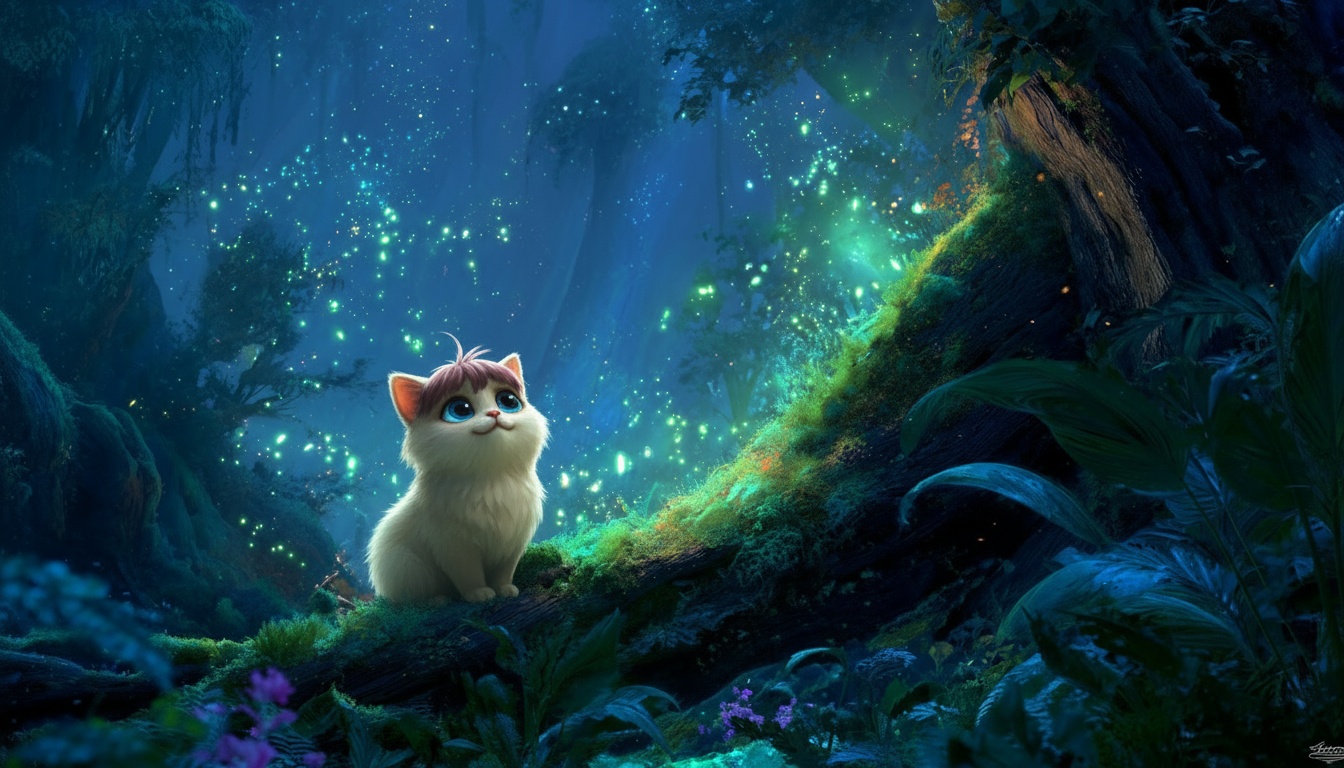
The small cat sits on the mossy log, tail curled neatly around its paws, eyes wide at the glowing particles drifting through the air. It stretches one paw upward to touch a floating light, claws barely out — the mote slips away and the cat blinks, ears flicking. Another cluster drifts closer; the cat rises, arches its back, and bats gently at them with quick, graceful swipes. Emboldened, it takes a light leap forward along the log, but its hind paw slides on the damp moss — it loses balance, flails for a moment, and tumbles off in an awkward little roll. Landing softly on its back, the cat blinks up at the glowing motes swirling above. It gives a small “mrrp,” flicks its tail lazily, then relaxes — paws slightly curled, whiskers glowing in the soft light as it watches the drifting sparks fade into the night sky.
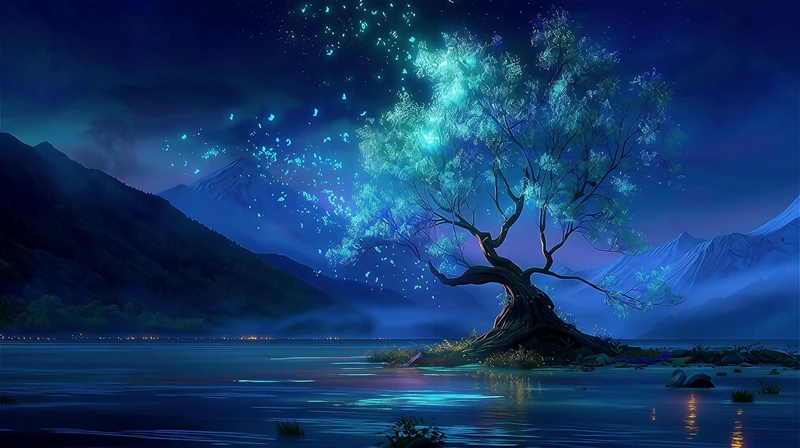
A cinematic 10-second shot of a glowing tree standing alone in the middle of a calm lake at night. The surface of the water ripples gently. Tiny luminous particles begin to rise slowly from the branches, drifting like floating embers. The camera tilts and drifts diagonally upward toward the left (up-left), smoothly following the ascending lights while keeping them near the center of frame. As the camera moves up-left, the tree slides toward the lower-right of frame and the distant mountains show a subtle rightward parallax, helping the diagonal motion feel natural. The sky opens gradually until the scene transitions into a vast night sky filled with countless stars. The moment feels peaceful, sacred, and infinite — as if the world itself is breathing.
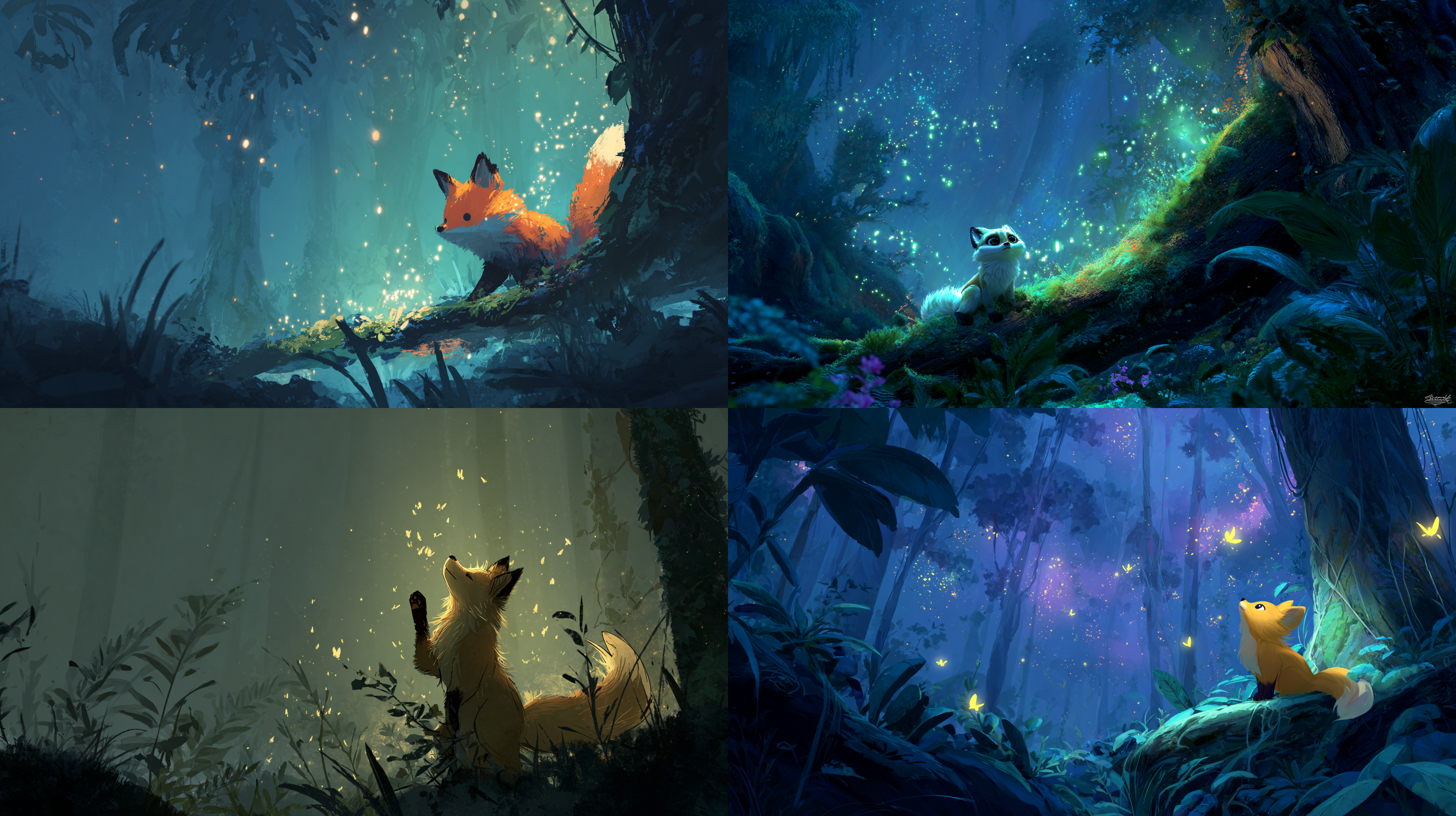
A single continuous, uninterrupted long take through a moonlit ancient forest at night. The camera glides low through mist and glowing moss until it finds a small fox-shaped forest spirit, softly luminous, struggling to climb a towering tree covered in dew and vines. Its paws slip against the wet bark; it digs its claws in, panting, tiny sparks trailing from its fur with each desperate effort. The creature stretches for a higher branch, but the root tears free — it loses grip and tumbles down through branches and leaves, glowing fragments scattering around it as it lands softly among moss and fireflies. The forest falls silent for a moment. Then, as the spirit lifts its head, its body shines brighter, pulsing with new light. The camera begins to rise in the same continuous motion, following the glow upward through the trees, accelerating rapidly until it bursts through the canopy. Above the forest, fifty thousand colorful luminous spirits soar into the night sky together, flying toward constellations, stars, and moons. The moment feels like release — a quiet miracle after struggle — painted in a hand-drawn watercolor style with soft animation lighting, gentle motion blur, and an ethereal atmosphere.
Details
- Generations
- 59 video, 59 image, 0 audio (includes takes the creator archived)
- Reference sheets
- A fox is sitting on a tree branch (used in 3 shots); A bright light shines through the trees (used in 2 shots); A fox sitting on a rock in front of a tree (used in 2 shots)
- Uploads
- 46 (frames and references)
- Powered by
- Nano Banana (50), Seedance Pro (36), Wan 2.5 (22), Flick (5), FLUX Kontext Pro (1), Midjourney (1), Seedance Lite (1), SeeDream (1)