Behind the film
- 254 video generations
- 364 image generations
- 11 models
- 1895 s of video generated
How it was made
-

Plan the film as timed beats
Jaime's blog post says the idea came first: what if stopping the rain is someone's job. The film was then planned in a note on the canvas as 11 timed beats, from the title card to a quiet ending on the clouds, most of them naming the shots they need.
First a hand reaches through the cloud top, then his head emerges, then he swings a leg over and climbs onto the cloud surface.
-

Choose one look and write it into every prompt
Everything is shot like a miniature model: tilt-shift, shallow depth of field. The first frames were made in Midjourney with that look at the start of the prompt, and the same look is described in 196 of the 254 video prompts. Jaime's blog post adds that small AI inconsistencies get lost in the blur.
Miniature diorama / tilt-shift macro look, shallow depth of field, warm late-afternoon haze.
-

Fix the character on a turnaround sheet
The herder lives on one sheet with front, left and back views. It was uploaded, then edited with Nano Banana Pro: realistic adult proportions, a slightly smaller head, and the cane swapped for a period umbrella. Versions of the sheet were references for more than 60 images.
Strictly preserve the composition and the three-view layout (FRONT / LEFT / BACK)
-

Swap him into finished frames
Scenes were made empty or with a stand-in first. Nano Banana Pro then got two images, the scene and the turnaround sheet, with instructions to keep the scene and only add or replace the man. That keeps him the same from the flooded street to the clouds.
Please use Image 2 as the base. Strictly preserve Image 2’s original composition, camera angle, street perspective
-

Make the clouds out of cotton
The clouds are cotton batting, so they belong to the same model world. Cloud images were edited into a cotton texture, and the stubborn cloud he has to deal with is a giant cotton block. 188 prompts describe cotton.
Transform the cloud layer in this image into a miniature diorama cotton-batting material.
-

Build the ladder shot from two images
The ladder into the storm combines a close-up of wet wood with the camera angle of another ladder image. Jaime's blog post tells how a "wrong" first image, a ladder in flat fog, was flipped in Photoshop and refined until it became the shot where he reaches the clouds. This ladder was used in 13 later shots.
Use the close ladder wood texture image as the Base. Use the ladder-into-storm-clouds image as the Reference for camera perspective and composition.
-

Animate with a locked camera and frame pairs
The stills were animated with Kling 3.0 Pro (125 clips) and Seedance Pro (114). About half the video prompts start by locking the camera to the frame, then describe one small action. For 44 clips the model got a first and a last frame and filled in the motion between them.
Locked camera, same framing/perspective/crop as input.
Assets
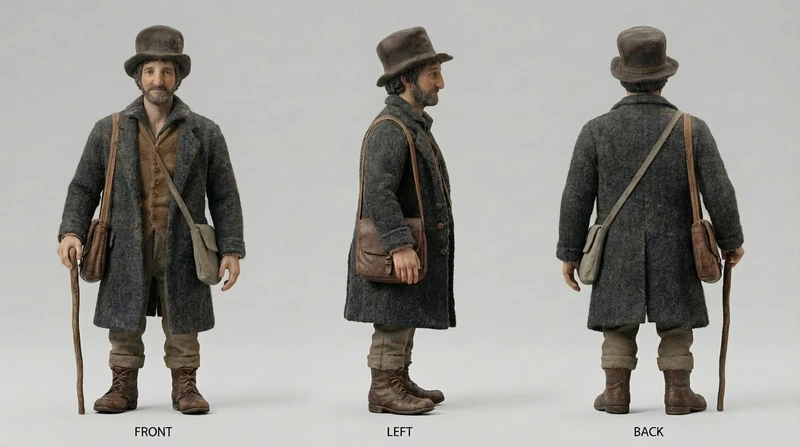 A man wearing a hat and coat: 13 shots use it
 A man sits in a cloud made of cake: 11 shots use it
 A ladder in the sky: 9 shots use it
 A white surface with a blue background: 9 shots use it
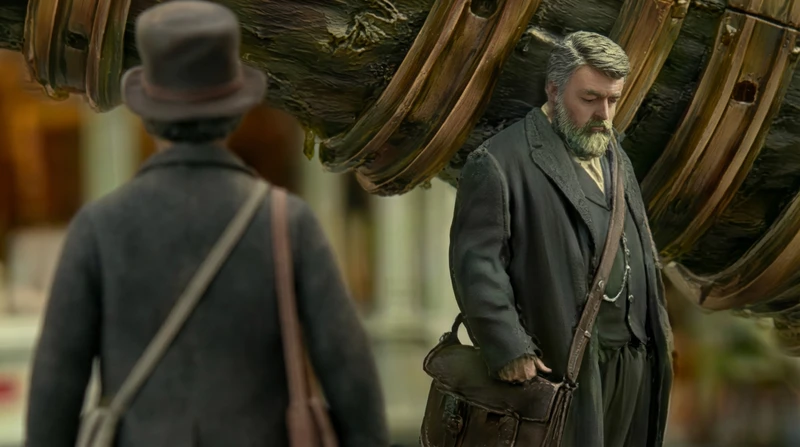 A man carrying a large bag: 8 shots use it
 A man stands in the rain next to a wagon: 8 shots use it
Prompts

Use image 1 as the base and image 2 as the reference. Keep image 1’s composition and camera exactly the same, including the fog brightness gradient, and keep the man and the ladder identical in position, scale, and sharpness. Preserve the character and ladder region unchanged; keep the action and silhouette the same; keep the ladder width and perfectly vertical orientation the same; the ladder bottom continues to fade softly into the fog. Adjust only the top “fog ceiling” material and form to match image 2: a compressed velvety cotton-felt / quilt surface with fine short fiber fuzz and subtle compressed layering/press marks. It reads as one continuous soft plane with slow, large-scale undulations and thicker, blunter edges. Blend it naturally into the fog below, keeping the overall look low-saturation, low-contrast, soft diffuse light.
Use the close ladder wood texture image as the Base. Use the ladder-into-storm-clouds image as the Reference for camera perspective and composition. Transform the Base into the same low-angle looking-up ladder shot as the Reference: ladder centered, strong one-point perspective, rungs converging to a single vanishing point, ladder rising upward and disappearing into a dark rolling storm cloud base, heavy rain streaks across the sky. Keep the ladder’s construction and material identity from the Base: thick square side rails, chunky rectangular rungs with rounded edges, rough aged timber grain, darker rain-soaked wood tone, heavy wet sheen, droplets hanging under rungs. Maintain a miniature diorama tilt-shift macro feel, very shallow depth of field, soft diffused overcast light, low saturation, low contrast, filmic realism
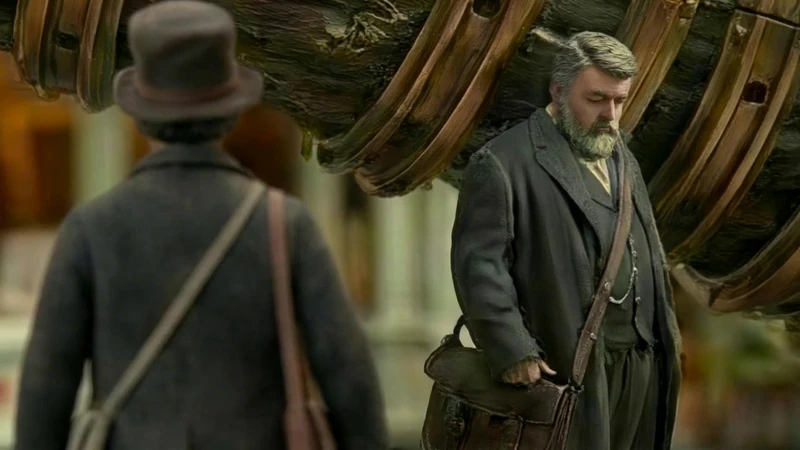
Same miniature diorama street and shallow macro depth of field, soft daylight. The fallen diagonal tree trunk wrapped in thin brass rings remains fixed in the background. Man A (heavyset, gray beard, dark long coat, leather satchel) starts with head lowered. Man B (slimmer, worn dark coat, round top hat, cross-body bags) is approaching from behind the camera, mostly back-facing. He carries a plain straight wooden walking stick: dark brown oak, matte and worn, about hip-height, a simple rounded knob handle, and a small metal ferrule at the tip. From the very first frame, Man B is already walking forward at a steady pace, using the walking stick in his right hand (continuous walking, no pause, no hesitation), entering from behind the camera. Man A raises his head and speaks clearly in English with visible lip-sync, saying: “Ah, Tuner Kagran. At last. I trust your journey was… agreeable. Ours, regrettably, has not been.” Action sequence (one continuous shot): Man A looks up toward Man B, then begins speaking. He delivers the quoted lines with clear mouth movement and slight pauses matching the punctuation. The speaking continues naturally across the approach, the handshake, and the start of walking toward the trunk (he does not need to finish all lines before moving). Man B continues walking forward while Man A speaks and arrives near Man A. Right before the handshake, Man B smoothly transfers the walking stick from his right hand to his left hand (a quick, natural hand-to-hand pass). He keeps the stick vertical with the tip still touching the cobblestones while his right hand becomes free. After this transfer, he continues holding the stick in his left hand through the handshake and while following alongside. During the second line — “I trust your journey was… agreeable.” — Man A steps forward and extends his hand, and they shake hands once (firm but brief), using Man B’s right hand. Immediately after the handshake, Man A turns his body toward the fallen trunk and gestures forward, then begins walking to lead Man B toward the trunk. Man B follows alongside, left hand holding the walking stick, as they approach the trunk together. Keep the environment unchanged. No camera movement. No new characters. This scene has a very handheld feel. Do not add any extra words. Speak exactly the quoted lines only.

Keep the same miniature diorama / tilt-shift macro look and shallow DOF. Heavy rainstorm, flooded street, no new people, no new objects, no text, no modern items. This scene has a very handheld feel. Camera is environment-priority and street-locked; do NOT track, follow, or center the protagonist. The protagonist stays SMALL in the midground near the left stalls/awnings. Camera move: ultra-slow lateral truck LEFT only for parallax. NO forward dolly-in, no zoom, no rise, no tilt. Add handheld energy by using subtle micro-jitter and slight uneven drift speed (tiny accelerations/decelerations), but still overall moving left the entire time. Use the existing protagonist already in frame near the left stalls. He is in side-profile the entire time (90°), facing RIGHT. He walks screen-space RIGHT only (not toward or away from camera), normal real-time cadence. Action micro-beats (physically grounded): He walks while tilting his head up, eyes toward the storm clouds, as if listening/reading the sky; his chin stays raised for a couple of steps. His front foot occasionally drags free from the water with suction; small splashes and ripples follow each step. The midground cart in the street begins to drift toward camera slightly due to the current (slow, uncontrolled slide with the water). Near-miss: because he’s looking up, he doesn’t notice the cart sliding into his path. When the cart gets close, he reacts late—his shoulders snap down, he jerks his head forward, and he abruptly takes one quick back-step to avoid contact. Almost-fall: that sudden back-step lands on a shifting submerged object / uneven cobble; his ankle rolls slightly and his torso tips. He windmills a small recovery: knees bend, core tightens, and he throws his weight back over his planted foot without fully falling. He pauses half a beat, lets the cart slide past in front of him, then resumes walking RIGHT with a steadier cadence, head still occasionally flicking up to the sky. Constraints: keep the street layout and props consistent; the cart’s motion is water-driven (no visible pulling). No additional people appear. No camera hold—camera continues the leftward move throughout and does not stop to “watch” the action.

Keep the exact same shot: a Gothic cathedral rooftop edge platform with flying-buttress details, a perfectly vertical wooden ladder anchored to a wooden box/base rig, rainy atmosphere, distant city blurred, same miniature tilt-shift DOF and material feel. The character is a small distant figure standing near the ladder on the platform edge, facing toward the camera side (can be slightly angled toward the ladder). Camera move: camera stays essentially in place with only a very subtle handheld breathing micro-jitter. No left/right slide, no forward push-in, no zoom, no rise/tilt. The character’s on-screen size and placement stay essentially constant. Action (grounded and natural micro-acting) Observation beat: he looks up along the ladder’s line, eyes scanning from mid-rungs to above the top edge (only eyes and a slight head lift—no big head throw). Rain hits the hat brim and shoulders; the coat gradually feels heavier with wetness. Micro-lean without stepping: he does not actually take a step; he slowly shifts weight onto the front foot, letting the torso “approach” the ladder by a tiny degree, as if about to move but stopping himself. Umbrella as a support point: the closed long-shaft umbrella stays tip-planted like a cane; he gently rotates the handle about half a turn, re-seating the tip so it “bites” into a slightly more secure spot on the slick boards. Finding traction: one foot makes a small adjustment—sole lightly scrapes the wet plank to test grip, then presses down to lock in; the knee softens and the center of mass drops slightly to brace against wind and rain. Resolve closure: he holds still for ~0.3–0.5s, breath visibly calmer; then his gaze shifts from the ladder to the stormy city in the distance and back to the ladder—quiet confirmation. He ends in a stable stance, umbrella still planted, ready for the next shot. Hard constraints: no extra people/props; do not make the ladder visibly sway; do not have him move off the platform or toward camera; no modern items/lights/text; keep rain and DOF style consistent.

Miniature diorama / tilt-shift macro cinematic look, shallow DOF. Heavy rain with wind-driven diagonal streaks. A narrow stone ridge platform at the very top of a Gothic cathedral roof; along the LEFT edge there is a very close, strongly defocused massive carved stone pillar/architectural element (foreground occluder). On the platform: a wooden crate and a vertically fixed wooden ladder secured with rope (the ladder continues upward and exits the top of frame). The distant city is fully blurred into foggy shapes. Camera (10s): camera is locked-off and does not move; only an extremely subtle “breathing” micro-jitter is allowed; absolutely no push-in/zoom/forward/back/left/right move/rise/tilt; composition and subject scale stay constant. Entrance logic (hard constraints): The first 6 seconds contain no person in frame. At second 6, a man must emerge from behind the left foreground defocused architectural/pillar occluder (as if stepping out of a hidden recess/passage), revealing shoulder and one hand first, then the full body. No window-opening, door-opening, curtain-lifting actions; no appearing from the ground/air; no new visible door/window structures added. Person (visible design): Male, wearing a dark long coat, a round top hat, and a cross-body satchel. Holding a long-shaft umbrella (closed) used like a cane: right hand holds it, tip planted on the stone. Action (simple and natural): After clearing the occluder he pauses for a beat, carefully tests footing on slick wet stone; torso leans slightly forward against wind. A restrained shoulder/back shake to shed rain (not exaggerated). Then he takes two short steps forward and stops near the platform edge, keeping his back to camera, head slightly raised, looking out toward the storm-soaked city and sky; no turning back. Other constraints: no extra people/birds/text/logos; do not alter the ladder/crate/rope rig; keep early-19th-century (no modern items).
Details
- Generations
- 254 video, 364 image, 1 audio (includes takes the creator archived)
- Reference sheets
- A man wearing a hat and coat (used in 13 shots); A man sits in a cloud made of cake (used in 11 shots); A ladder in the sky (used in 9 shots)
- Uploads
- 116 (frames and references)
- Powered by
- Nano Banana Pro (359), Kling 3.0 Pro (125), Seedance Pro (114), Kling O3 Pro (7), Midjourney (4), Wan 2.6 (4), Seedance 1.5 Pro (2), Eleven v3 (1), Kling 2.6 Pro (1), Kling AI Avatar v2 Pro (1), Riverflow 2.0 Pro (1)