Wie man mit Kling AI in 7 Schritten einen Kurzfilm erstellt
Um Kling AI für einen Kurzfilm zu verwenden, gib ihm ein fertiges Startbild und schreibe dann jede Einstellung als eine Kamerabewegung, eine Aktion und eine gesprochene Zeile, mit einer Liste von Dingen, die vermieden werden sollen.
Die meisten ersten Kling-Videos driften ab: Gesichter ändern sich zwischen Einstellungen, die Kamera wandert, und die Stimme ist jedes Mal anders. Karan Archana machte Drop of Water, ein 3:21 Dürre-Drama für die Summer 2026 Flick Residency, mit 89 Kling 3.0 4K-Clips auf einem Flick Canvas. Wir haben jeden einzelnen dieser Prompts und ihre Einstellungen gelesen. Dieser Leitfaden zeigt, wie man Kling AI so verwendet, wie Karan es tat, in sieben Schritten, jeweils mit einer echten Einstellung aus dem Film und dem exakten Prompt, der sie erstellt hat.
Kling-Videomodelle in Flick laufen ab dem Standard-Plan und höher.
Professional character turnaround reference sheet for Ken: a late 30s South Asian man, medium brown skin, lean athletic build around 5'10", short slightly wavy black hair, sharp tired intelligent eyes, strong jaw, wearing dark slim-fit cargo trousers, a fitted grey technical shirt, lightweight jacket, heavy duty boots. Create ONE wide image showing SIX panels: full body front view, full body left profile, full body right profile, full body back view, AND one close-up of face from the right side, AND one close-up of face from the left side. Same character in every panel, 100% identical face and clothing matching the reference exactly, neutral A-pose for full body panels, plain pure white seamless background, even flat lighting, orthographic framing. No scene, no props, no other people.
Bedeutung:Eine professionelle Charakterreferenz zeigt Ken, einen südasiatischen Mann Ende dreißig, in sechs Ansichten auf weißem Hintergrund.
Klings Image-to-Video beginnt mit deinem Bild, daher legte Karan zuerst jedes Bild fest und passte ein Standbild aus einer früheren Einstellung mit beiden Ken-Sheets an.
Bild 1 ist die Szene, Bild 2 und 3 sind die Sheets.
Eine Änderung: eine enge Nahaufnahme von Ken allein, ohne Evelyn.
Erstellt mit Nano Banana Pro; jeder der 89 Kling-Clips begann mit einem solchen Bild.
Drop of Water, Regie: Karan Archana · Nano Banana Pro
Image 1 is the scene: a two-shot of the man Ken (left, glasses, brown vest over grey tee, curly hair, beard) drinking green liquid from a transparent sachet in a dim dusty room, with the woman Evelyn on the right. Images 2 and 3 are reference sheets of Ken — use them to keep his face 100 percent accurate: exact features, glasses, beard, hairstyle, skin texture. Re-frame this into a tight close up on Ken ALONE, filling the frame, in the exact same moment of raising the transparent sachet to his lips and drinking, eyes lowered. Evelyn is completely gone from the frame and must not be visible at all. Keep everything from image 1 identical: Ken's identity, his clothing, the sachet with green liquid, the dim dusty room, the warm muted color palette, window light, lighting mood and photorealistic texture and grain. Shallow depth of field, background soft. Grounded cinematic realism.
Bedeutung:Ken allein in enger Nahaufnahme hebt den durchsichtigen Beutel mit grüner Flüssigkeit an die Lippen im dämmrigen staubigen Raum.
Schritt 3
Benenne eine Kamerafahrt
Beschreibe eine Kamerafahrt, wo sie beginnt, wie schnell sie ist und wo sie endet, damit Kling keine eigenen Pushes oder Schnitte erfindet.
Ein einzelner Schwenk, von links nach rechts, entlang des Zauns.
Die Geschwindigkeit ist ausformuliert: etwa ein Drittel eines normalen Schwenks.
Das Schild kommt ins Bild, hält kurz an und verlässt es wieder.
Die Länge wird neben dem Prompt eingestellt: 3, 5, 10 oder 15 Sekunden bei Kling 3.0 4K.
Erster Frame00:10
Drop of Water, Regie: Karan Archana · Kling 3.0 4K · Bild zu Video
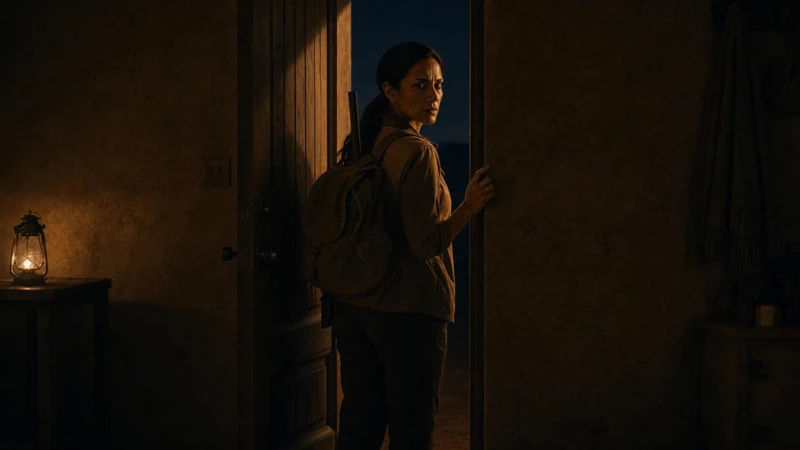
The camera begins at the far left end of the barbed wire fence, framing only the rusted wire strands stretching across the blood-orange desert horizon. A very slow, almost glacial pan moves right along the fence line — the wire fills the frame, repeating rhythmically, the cracked earth below and the smoky red sky above. The pan speed is extremely slow — the camera should move only about one third of the distance it would in a normal pan over the full 5 seconds. The fence seems endless. Then, gradually, the weathered wooden post and the rusted "ENTRY TO NORTHLAND IS PROHIBITED" sign drift into frame. The camera barely lingers on the sign for a beat — just long enough to register its presence — then continues its imperceptibly slow pan to the right. The sign drifts out of frame. Only fence wire remains. The world is silent, red, and still. No rush. No acceleration. The entire shot breathes slowly.
Bedeutung:Eine extrem langsame Kamerafahrt gleitet entlang eines rostigen Stacheldrahtzauns durch eine blutrote Wüstenlandschaft mit verbotenem Schild.
Schritt 4
Liste auf, was vermieden werden soll
Teile den Prompt in die Szene, eine kurze Liste der erlaubten Bewegungen und eine VERMEIDEN-Liste auf, damit Kling eine ruhige Performance ruhig hält.
Die Animations-Liste umfasst fünf Zeilen, je eine Bewegung.
Die VERMEIDEN-Liste verbietet sowohl schauspielerische Entscheidungen als auch Kamerafahrten.
59 der 89 Kling-Prompts im Film enden mit einer solchen Liste.
Erster Frame00:05
Drop of Water, Regie: Karan Archana · Kling 3.0 4K · Bild zu Video
Prompt

Continue inside the same weathered house immediately after Ken lowers the government-issued water ration pouch. Maintain identical lighting, wardrobe, production design, and atmosphere. Ken stands near the back sliding door, his body still facing the window. After a long moment of silence, he slowly turns his head just enough to acknowledge Evelyn without fully facing her. His expression is calm, compassionate, and tired. He speaks quietly and gently, without anger or urgency. Evelyn stands a few feet behind him, listening in silence. She remains almost perfectly still. The camera is locked in a medium shot with an almost imperceptible slow push forward. Natural breathing, subtle eye movement, restrained body language. Photorealistic live-action film, grounded realism, naturalistic cinematography, practical production design, documentary authenticity.

Animation
Ken slowly turns his head.
Speaks quietly.
Evelyn listens without moving.
Dust drifts in the light.
No other movement.

AVOID :

Dramatic acting, exaggerated emotion, crying, shouting, large gestures, camera shake, handheld movement, camera pan, zoom, cinematic swoops, cartoon style, text, logos, AI artifacts.
Bedeutung:Ken dreht langsam seinen Kopf und spricht leise zu Evelyn in einem staubigen Raum mit natürlichem Licht und dokumentarischer Atmosphäre.
Schritt 5
Schreiben Sie die Zeile in Anführungszeichen
Setzen Sie die genauen Worte in Anführungszeichen und beschreiben Sie, wie sie gesagt werden, denn Kling 3.0 4K generiert die Stimme zusammen mit dem Bild.
Eine Zeile, fünf Wörter, mit dem Atemzug und Kopfschütteln davor.
Die Sprechweise wird beschrieben: ruhig, tief, sachlich.
Eine gehaltene Stille nach der Zeile, in den Prompt geschrieben.
Der Ton kommt von der Einstellung Audio generieren, standardmäßig aktiviert.
Erster Frame00:05
Drop of Water, Regie: Karan Archana · Kling 3.0 4K · Bild zu Video
Use the attached image as the exact first frame. Preserve the exact composition, characters, clothing, lighting, colour palette, room, lens, camera position and cinematic realism. Continue directly from the previous shot.

Preserve Evelyn's existing voice exactly as established in the previous dialogue scenes. Use the same voice, accent, tone, cadence, pitch, emotional restraint and vocal characteristics already heard in the film. Do not generate a new voice or alter her vocal performance in any way. This line should sound like it is spoken by the same Evelyn from the preceding scene.

Evelyn maintains eye contact with Ken in silence. Her expression is weary, composed and quietly devastated. She takes one small breath, gives the slightest shake of her head and softly says:

"They're not coming back."

Her delivery is calm, low and matter-of-fact. She is not trying to convince Ken—she has already accepted what he cannot. After speaking, she remains still, holding his gaze for two seconds without speaking.

Ken remains softly out of focus in the foreground and barely moves. The camera stays completely locked off. Natural lip synchronization, subtle breathing, one slow blink, grounded cinematic realism.

Avoid

Do not change Evelyn's voice. Do not synthesize a different accent, pitch, cadence or emotional style. Do not make her sound younger, older, robotic or theatrical. Do not alter her face, hairstyle, clothing, posture or eyeline. Do not change Ken, the room, lighting, framing or colour grade. No camera movement, zoom, push-in, rack focus or reframing. No crying, shouting, trembling lips, exaggerated facial expressions or dramatic gestures. Do not add dialogue before or after the exact line. Keep Ken softly out of focus and Evelyn in sharp focus throughout.
Bedeutung:Evelyn hält Blickkontakt mit Ken und sagt ruhig sie kommen nicht zurück in gedämpftem realistischem Licht ohne Kamerabewegung.
Schritt 6
Schnitt zur Antwort
Filmen Sie eine Konversation als einen Kling-Clip pro Zeile, jeder beginnt mit einer neuen Over-the-Shoulder-Einstellung und fordert die bereits gehörte Stimme an.
Die Gegenperspektive des letzten Schritts, erstellt aus einem Standbild einer früheren Aufnahme.
Der Prompt wiederholt die Anweisung für die Stimme und die fixierte Kamera.
Karans eigene Notiz zur Formulierung ist noch im Prompt, zitiert wie geschrieben.
Erster Frame00:05
Drop of Water, Regie: Karan Archana · Kling 3.0 4K · Bild zu Video
Use the attached image as the exact first frame. Preserve the exact composition, camera angle, lens, lighting, colour palette, production design, costumes and photorealistic cinematic style. Continue directly from the previous dialogue shot.

Preserve Ken's existing voice exactly as established in the previous dialogue scenes. Use the same voice, accent, cadence, pitch, emotional restraint and vocal characteristics already heard in the film. Do not generate a new voice or alter his vocal performance in any way. This line must sound as though it is part of the same continuous conversation.

Ken maintains eye contact with Evelyn, who remains softly out of focus in the foreground. He hesitates for a moment, searching her face before quietly asking:

"What if they come home... and no one is here?"

His voice is gentle, tired and quietly hopeful. He is not arguing with Evelyn. He is holding on to the last possibility that their daughters might still return. The line is spoken softly, with a small pause after "come home..." as he struggles to finish the thought.

After speaking, Ken continues looking at Evelyn in silence. He takes one subtle breath, blinks once naturally and remains completely still. Hold the silence for one to two seconds after the line finishes.

The camera remains perfectly locked off. Natural lip synchronization. Subtle breathing. Grounded cinematic realism.

Performance Notes
Quiet, restrained delivery.
No anger.
No pleading.
No melodrama.
His hope is fragile rather than desperate.
Let the silence after the line carry as much emotion as the dialogue itself.
Avoid

Do not change Ken's voice, accent, pitch or cadence. Do not alter Ken's face, hair, glasses, clothing, posture or eyeline. Do not change Evelyn's silhouette, the room, fireplace, lighting, framing or warm amber colour grading. No camera movement, zoom, push-in, pan or rack focus. No tears, shouting, dramatic gestures, exaggerated facial expressions or theatrical acting. Do not add dialogue before or after the exact line. Preserve the intimate, quiet realism of the surrounding scene.

I also think the wording "come home" is stronger than "come back." Earlier, Evelyn says, "They're not coming back." Then Ken asks, "What if they come home... and no one is here?" The repetition of the same idea from opposite emotional perspectives gives the exchange a quiet symmetry without feeling repetitive.
Bedeutung:Ken fragt Evelyn leise und hoffnungsvoll, ob ihre Töchter heimkommen könnten, während er sie ansieht in warmem, kinorealistischem Licht.
Schritt 7
Eine Aufnahme korrigieren, den Rest behalten
Wenn ein Objekt in einer guten Aufnahme falsch ist, bearbeiten Sie den Clip mit Kling O3 Pro, anstatt ihn neu zu generieren, und listen Sie alles auf, was gleich bleiben muss.
Das Beutelchen in Kens Hand hatte sich zwischen den Aufnahmen verändert, also ersetzt die Bearbeitung das Beutelchen und nichts anderes.
Der Prompt listet auf, was erhalten bleiben soll, von der Bildkomposition bis zum Timing des Dialogs.
Die Bearbeitung behält den Originalton der Aufnahme bei und wird pro Sekunde des Quellclips abgerechnet.
Edit only the empty water sachet in Ken's left hand. Do not change anything else.

This is a continuity correction.

Replace the current sachet with the same almost-empty transparent plastic water sachet containing only a small amount of bright green liquid exactly as it appears in the previous shot (reference image attached).

The sachet must:

remain in Ken's left hand throughout the entire shot
have the same size, shape, folds, transparency, remaining liquid level and orientation as the previous shot
move naturally with his hand as he turns toward Evelyn
never disappear, refill, change color or change shape

Do not alter anything else.

Preserve exactly:

camera framing
composition
lens
lighting
warm amber color palette
Ken and Evelyn's faces
body positions
clothing
dialogue timing
background
room
facial expressions
pacing

The only change should be replacing the incorrect sachet with the matching continuity sachet from the previous shot.

This is a precision continuity edit, not a regeneration. Maintain cinematic realism in the style of Denis Villeneuve and Children of Men.

One additional suggestion: attach two reference images if Flick allows it.

The last frame of the previous shot, where the sachet is correct.
The first frame of the current shot, where everything is correct except the sachet.

That gives Flick a very explicit "copy from A, paste into B" task, which generally produces more reliable continuity edits than relying on a text description alone.
Bedeutung:Kens fast leerer grüner Wasserbeutel in seiner linken Hand wird für Kontinuität korrigiert, alles andere bleibt unverändert.
Welche Kling-Einstellungen hat ein echter Kurzfilm verwendet?
Kurze Clips mit Ton: 57 der 89 Kling 3.0 4K-Clips in Drop of Water laufen 5 Sekunden, und alle 89 generieren Audio.
Die 89 Kling 3.0 4K-Clips auf dem öffentlichen Drop of Water-Canvas, abgerufen am 26.10.2026. Ein Prompt kann in mehr als einer Zeile gezählt werden.
Wonach der Clip fragt
Clips
5 Sekunden lang
57
10 Sekunden lang
28
15 Sekunden lang
4
Audio generiert
89
Eine Vermeidungsliste im Prompt
59
Eine fixierte oder statische Kamera
51
Setzt die vorherige Einstellung fort
50
Eine gesprochene Zeile in Anführungszeichen
29
Ein End-Frame sowie ein Start-Frame
1
Mehr Details: wie wir gezählt haben
Wir lesen die Einstellungen und den Prompt jedes Kling 3.0 4K-Clips, der auf dem öffentlichen Canvas des Films gespeichert ist. Uploads und gelöschte Takes werden nicht gezählt.
Vermeidungs-Liste: das Wort „avoid" im Prompt.
Festgestellte Kamera: „locked", „no camera movement" oder „the camera remains completely still".
Fortsetzung: „previous shot", „last frame", „final frame" oder „continue".
Gesprochene Zeile: ein Paar doppelte Anführungszeichen im Prompt.
Der durchschnittliche Prompt ist 176 Wörter lang.
Fragen zur Verwendung von Kling AI
Was ist Kling AI?
Kling ist eine Familie von KI-Videomodellen von Kuaishou, die ein Startbild und einen Text-Prompt in einen Videoclip verwandeln, viele davon mit Ton. In Flick läuft Kling auf demselben Canvas wie Bildmodelle, sodass ein Charakterbogen, ein Start-Frame und der Clip nebeneinander liegen.
Welche Kling-Modelle kann ich in Flick verwenden?
Für Bild-zu-Video: Kling 3.0 4K, Kling 3.0 Pro, Kling 3.0, Kling O3 Pro, Kling O3 und Kling 2.6 Pro. Das neueste, Kling 4.0, kam am 26. Oktober 2026 zu Flick, nachdem Drop of Water erstellt wurde, daher sind die Clips in diesem Leitfaden Kling 3.0 4K. Flick hat auch Kling O3 Pro Multishot für Multi-Shot-Clips aus Referenzbildern, Kling AI Avatar v2 für sprechende Avatare, Kling O3 Pro Videobearbeitung und Kling Image V3 für Bilder.
Ist Kling AI kostenlos nutzbar?
Kling-Video in Flick benötigt den Standard-Plan oder höher, ab 20 $ pro Monat. Kling Image V3 ist im Free-Plan verfügbar, und Flick gibt 100 Credits bei der Anmeldung.
Wie viele Credits kostet ein Kling-Video in Flick?
Ein Kling 3.0 4K-Clip kostet 330 Credits in seiner Standardlänge und 990 Credits in seiner längsten Länge. Eine Kling O3 Pro-Bearbeitung wird pro Sekunde des bearbeiteten Clips abgerechnet.
Wie lang kann ein Kling-Video sein?
Ein Kling 3.0 4K-Clip in Flick läuft 3, 5, 10 oder 15 Sekunden. Für eine längere Szene startest du den nächsten Clip mit dem letzten Frame des vorherigen, so wie Drop of Water seine Aufnahmen verkettet.
Kann Kling AI Dialoge mit Ton erzeugen?
Ja. Kling 3.0 4K generiert Audio zusammen mit dem Bild, wobei die Einstellung Audio generieren standardmäßig aktiviert ist. Schreibe die genaue Zeile in Anführungszeichen, wer sie sagt und wie, und beschreibe die Stille davor und danach.
Wie behalte ich denselben Charakter in jeder Kling-Aufnahme?
Erstelle zuerst ein Charakterblatt, baue dann jeden Startframe daraus mit einem Bildmodell auf und animiere zuletzt in Kling. Der Startframe trägt das Gesicht, sodass das Videomodell es nie erraten muss.
Kann Kling einen Start- und einen Endframe verwenden?
Kling 3.0 4K nimmt einen optionalen Endframe: Ja. Gib ihm das erste und letzte Bild einer Aufnahme, und Kling erzeugt die Bewegung dazwischen.
Jede Aufnahme auf dieser Seite stammt aus dem öffentlichen Drop of Water-Canvas und ist dem Filmemacher Karan Archana zugeschrieben. Prompts sind exakt so zitiert, wie sie auf dem Canvas geschrieben wurden.
Mache deinen ersten Kling-Kurzfilm in Flick
Charakterblätter, Startframes und alle Kling-Videomodelle auf einem Canvas, so wie Drop of Water gemacht wurde.



 00:10